
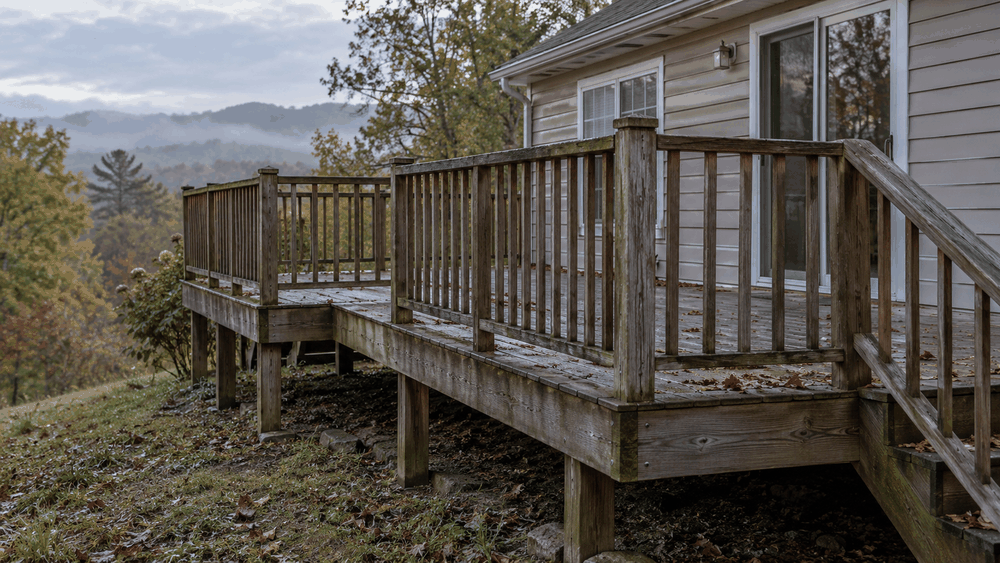
There's a homeowner in Radford we talked to two Aprils ago who said something we've heard some version of a hundred times since.
"It wasn't this bad in October."
He was right. It wasn't. In October his deck had a few soft spots near the stairs, some cupping on the boards along the south edge, and a rail section that moved more than he liked. He looked at it, decided it could hold on, and told himself he'd deal with it in the spring when the weather broke and he had the money lined up.
Then winter happened to it.
By April the soft spots had opened into holes. Two joist ends had gone punky where the stair stringers met the frame. The cupped boards had split at every fastener. And the rail section that moved a little in October moved a lot in April, because the post it was anchored to had been sitting in freeze-thaw for six months with water in it.
The repair he'd been quoted in October turned into a different project entirely.
He didn't do anything wrong. He did what almost everybody does. He just didn't know what the calendar was going to do to the thing he was putting off.
TL;DR — What This Post Will Tell You
- Blacksburg's average first freeze is October 10th, and the last spring frost lands in the first ten days of May. That's seven months of freeze-thaw on whatever moisture your deck took on this fall.
- Freeze-thaw widens existing cracks, backs fasteners out a fraction at a time, and accelerates rot on the top edge of joists where water sits and never dries.
- Sealing and staining has a real deadline — most products need 50°F or above through curing, no freeze for 8 to 12 hours after, and wood at or below about 15% moisture. Active structural failure also shouldn't wait for spring.
- A deck that's sound but tired is the opposite: fall is the time to get assessed and plan, and you land on the schedule ahead of the spring rush instead of behind it.
Table of Contents
The date
The National Weather Service office in Blacksburg keeps freeze records for the region going back decades. Their number for Blacksburg is the one worth writing down:
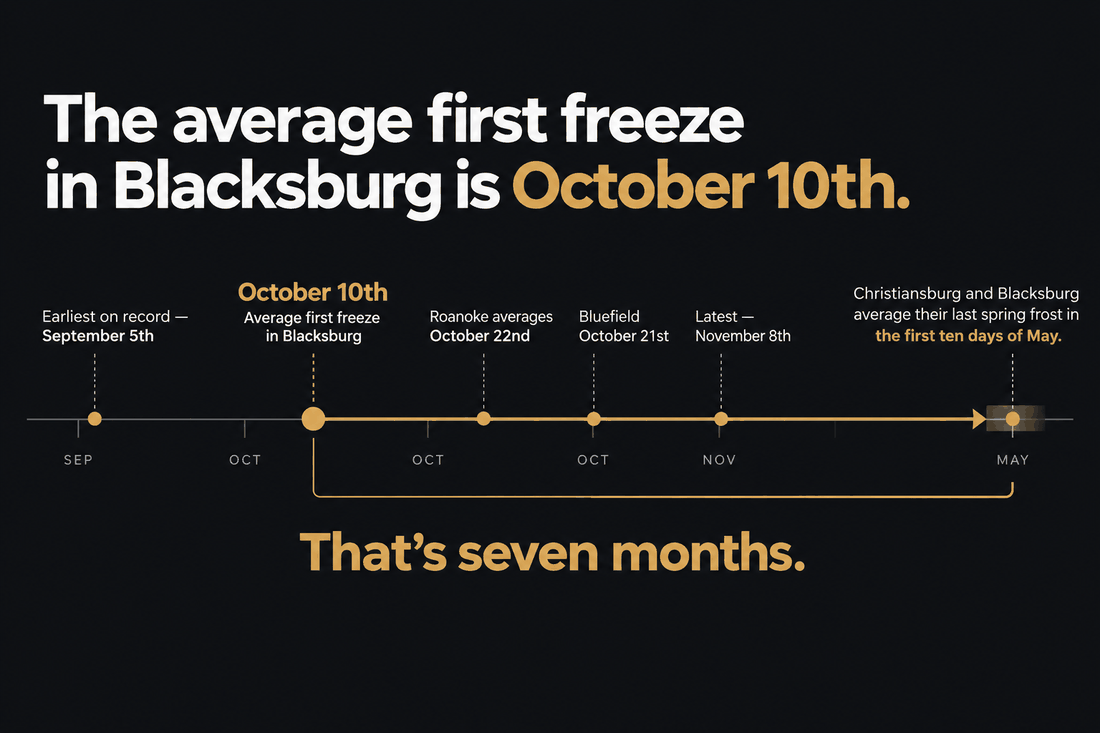
The average first freeze in Blacksburg is October 10th.
The earliest on record is September 5th. The latest is November 8th. Roanoke averages October 22nd, Bluefield October 21st — so if you live down in the valley you get a couple of extra weeks, and if you're up on the plateau you don't.
Now pair that with the other end. Christiansburg and Blacksburg average their last spring frost in the first ten days of May.
That's seven months.
Seven months of your deck going below freezing at night and back above it during the day, over and over, while it holds whatever moisture it took on that fall. Nobody's out there watching it. That's the part that matters.
What freezing actually does to a deck
This is the part almost nobody explains, so here it is plainly.
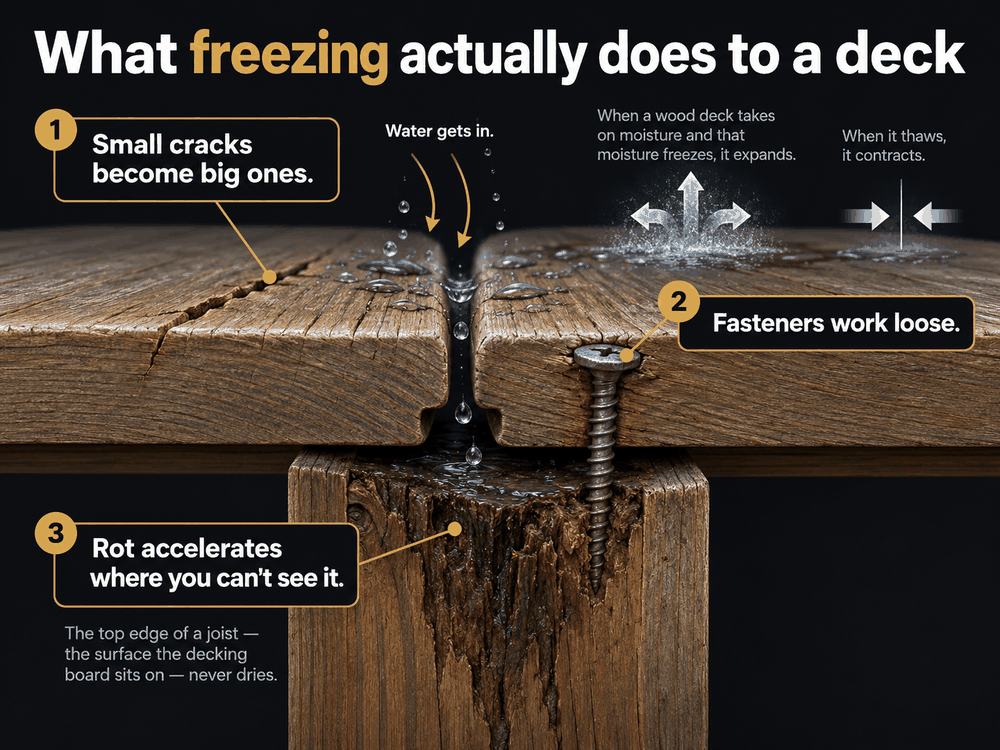
Wood is not waterproof. Pressure treatment resists rot; it does not stop the board from absorbing water. When a wood deck takes on moisture and that moisture freezes, it expands. When it thaws, it contracts. Do that a few dozen times across a winter and three things happen:
Small cracks become big ones. Every existing check, split and screw hole is a place water gets in. Freeze it and the crack widens. Thaw it and more water gets in than last time. This is why a board with hairline checking in October is a board with a split running its length by April.
Fasteners work loose. The wood moves around the screw or nail; the screw doesn't move with it. Every cycle backs it out a fraction. This is the actual mechanism behind a railing that's "suddenly" wobbly in spring — it wasn't sudden, it was one hundred and fifty small movements.
Rot accelerates where you can't see it. Here's the one that costs people the most money. The top edge of a joist — the surface the decking board sits on — never dries. Water runs between the boards, sits in that contact seam, and stays there. Cold weather doesn't kill rot fungus; it just makes it dormant and then wakes it up again. Every winter with trapped moisture in that seam is another winter of decay in the one part of the frame you'd have to replace the whole surface to see.
That's the honest reason a deck looks worse in April than it did in October. Not neglect. Physics.
Before we go further
This is the part where a deck company tells you the sky is falling and you have three weeks to act.
So let's be straight about what we're actually saying, because there are two very different jobs here and only one of them is on a clock.
The work that genuinely has a deadline
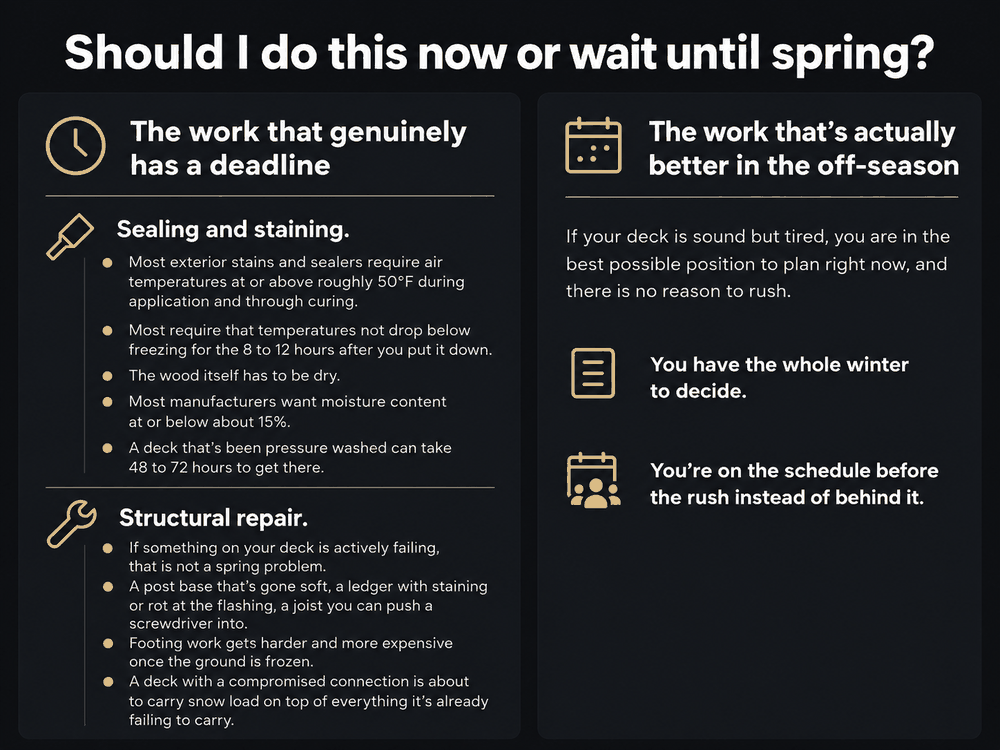
Sealing and staining. This one is not negotiable and it is not us being dramatic — it's product chemistry. Most exterior stains and sealers require air temperatures at or above roughly 50°F during application and through curing, and most require that temperatures not drop below freezing for the 8 to 12 hours after you put it down. On top of that, the wood itself has to be dry — most manufacturers want moisture content at or below about 15%, and a deck that's been pressure washed can take 48 to 72 hours to get there.
Now look at the Blacksburg calendar again. Average first freeze October 10th. Shortening days. Dew that doesn't burn off until mid-morning and comes back before dinner.
The realistic staining window in the New River Valley closes in the first half of October most years. Not because we say so — because the can says so.
If your deck is unsealed right now, it is going to spend seven months absorbing and freezing water, and the bill for that shows up in the spring.
Structural repair. If something on your deck is actively failing — a post base that's gone soft, a ledger with staining or rot at the flashing, a joist you can push a screwdriver into — that is not a spring problem. It's a right-now problem, for two reasons. Footing work gets harder and more expensive once the ground is frozen. And a deck with a compromised connection is a deck that's about to carry snow load on top of everything else it's already failing to carry.
The work that's actually better in the off-season
Here's the part most deck companies won't tell you, because it's not the part that gets a check signed this month.
If your deck is sound but tired, you are in the best possible position to plan right now, and there is no reason to rush.
Deck contractors in Southwest Virginia are buried from March through July. Everybody decides on the same Saturday in April that this is the year. If you call us in May, you're getting in line behind everyone who called in April.
If you have your RE-Assessment done in October, you know exactly what you're dealing with, you have the whole winter to decide, and you're on the schedule before the rush instead of behind it. Nothing gets built in January. But everything gets decided in January by the people who were smart enough to get the information in October.
So the honest answer to "should I do this now or wait until spring" is: it depends entirely on which category your deck is in, and that's a forty-five minute conversation, not a guess.
The fifteen-minute walkaround, right now
Before the first freeze, do this. It costs you nothing and it tells you which conversation you're having.
- 1Push on every railing section and every post. Not a gentle nudge — lean on it the way a grown adult leans on it at a cookout. Any movement at all gets written down.
- 2Look at where the deck meets the house. You're looking for dark staining, rusted fasteners, gaps, or any sign water is running behind the ledger instead of shedding off it.
- 3Get low and look at the base of every post. Where the post meets concrete or dirt is where rot begins. If the wood is dark, spongy, or you can sink a key into it, that's your answer.
- 4Walk the whole surface slowly and feel for flex. A board that gives underfoot is usually telling you about the joist under it, not the board.
- 5Look at the underside of the deck if you can get there. Take a flashlight. Probe the top edge of two or three joists with a screwdriver near the house end, where water collects.
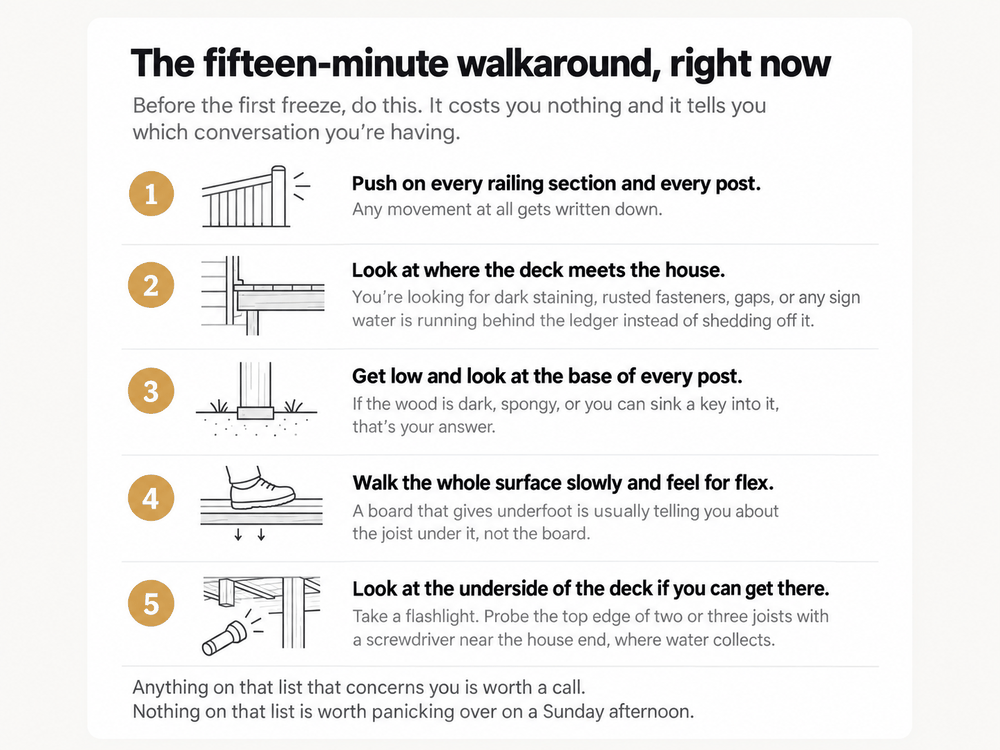
Anything on that list that concerns you is worth a call. Nothing on that list is worth panicking over on a Sunday afternoon.
Where this leaves you
You've almost certainly already had the thought. Most people in the New River Valley looked at their deck sometime in the last month, noticed something, and filed it under spring.
That instinct isn't laziness — it's reasonable. Spring is when you use a deck. Spring is when the money feels less tight. Spring is when the weather cooperates.
The only problem with it is that the deck doesn't wait for spring. It spends the seven months in between getting worse in ways you can't see from the back door, and the difference between a repair and a rebuild is very often just how many winters went by while somebody meant to get to it.
What's the version of this you're hoping isn't true?
Our RE-Assessment is free, it takes about forty-five minutes, and you end it knowing three things: whether your structure is sound, whether anything on it needs attention before it freezes, and what it would take to fix. No obligation, no pressure, and if the answer is "your deck is fine, seal it and enjoy it," that's what we'll tell you.
Would it be a bad idea to find out before the first freeze instead of after the last one?
Call ReDeck Virginia at (540) 585-1720 or request your free RE-Assessment at redeckva.com. We repair, resurface and rebuild decks across Christiansburg, Blacksburg, Radford, Dublin, Pulaski and Salem.
RePair. ReDeck. RePlace.
Frequently asked questions
Most exterior stains need air temperatures around 50°F or above during application and through curing, with no freeze for 8 to 12 hours after. With Blacksburg's average first freeze on October 10th and shorter drying days through the fall, the practical window in the New River Valley usually closes in the first half of October. Always check the product label — minimums vary by formula.
Cold alone doesn't. Cold combined with moisture does. Water absorbed into the wood expands when it freezes and contracts when it thaws, widening existing cracks, backing fasteners out, and accelerating decay in places that stay wet — particularly the top edge of joists where decking boards sit.
If something is actively failing — soft post bases, a compromised ledger, joists you can penetrate — it should be addressed before the ground freezes and before the deck carries snow load. If the structure is sound and the deck is simply worn, fall is the ideal time to get assessed and plan, with the work scheduled ahead of the spring rush.
Much of it, yes, depending on conditions. Structural repair, framing work and board replacement can often proceed in cold weather. Finishing work — staining and sealing — cannot, because the product will not cure.
About forty-five minutes. It includes getting underneath the deck to inspect the ledger, posts, footings, joists and connections, and it ends with a clear answer on whether your deck needs repair, resurfacing or replacement.
About ReDeck Virginia
ReDeck Virginia is a Class A licensed, insured deck specialist based in Christiansburg, VA, serving homeowners across the New River Valley and SW Virginia. We repair, resurface (ReDeck), and rebuild decks — and we always start by telling you the truth about what yours actually needs.