
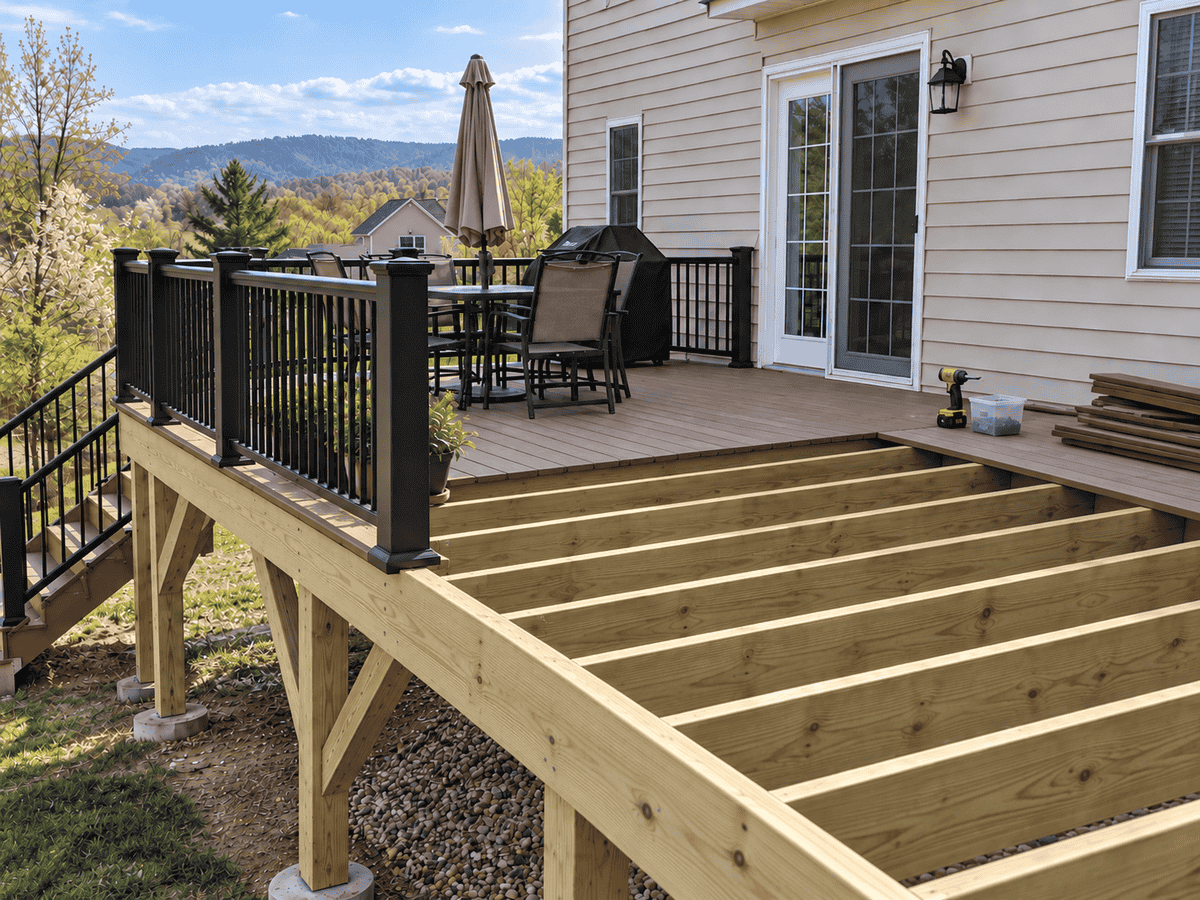
A homeowner in Christiansburg called us this summer with two quotes sitting on his kitchen table.
Same deck. Same square footage. Same back of the same house. One quote came in at $11,600. The other came in at $21,000.
He wanted to know which contractor was trying to take him.
Neither one was. And once you understand why those two numbers can both be honest, you'll understand more about deck pricing than most homeowners in the New River Valley ever find out — usually because they signed before they asked.
Here's the thing that made the difference. It wasn't the boards. It wasn't the railing. It wasn't the crew.
It was a decision one contractor made before he ever wrote a number down, and the other one never made at all.
TL;DR — What This Post Will Tell You
- Two honest quotes on the same deck came in $9,400 apart: $21,000 to tear it down and rebuild, $11,600 to keep the frame and rebuild the surface.
- Commodity framing lumber softened in 2026, but the materials a deck is actually built from — copper-treated lumber, steel connectors, imported softwood — did not.
- That means the half of a deck that got more expensive is the structural half, which is the half you may already own.
- Five checks decide whether a frame is keepable: the ledger, the posts and footings, the joists, the connections, and the joist spacing if you want composite.
Table of Contents
- 1. What's actually inside a deck quote
- 2. The reveal: which half of the deck got more expensive in 2026
- 3. The $9,400 question
- 4. What makes a frame keepable
- 5. RePair. ReDeck. RePlace.
- 6. "Doesn't a new deck add more value, though?"
- 7. What to ask any contractor before you sign
- 8. Where this leaves you
- 9. Frequently asked questions
What's actually inside a deck quote
Every deck quote in Southwest Virginia is built out of the same seven buckets. Homeowners almost never see them broken out, which is exactly why two quotes can look identical on the outside and be nine thousand dollars apart on the inside.
- 1Demolition and haul-off — tearing the old deck out and getting it off your property
- 2Footings — the concrete below the frost line that holds everything up
- 3Posts and structural frame — beams, joists, ledger, the skeleton
- 4Hardware — joist hangers, post bases, structural screws, flashing
- 5Surface — the boards you actually walk on
- 6Railings, stairs and guards — the safety system
- 7Permit and inspection — required, and worth talking about separately
Look at that list again and notice something. Only one of those seven buckets is the part you look at.
The other six are the part you stand on.
When a homeowner shops decks, he shops the surface — Trex or pressure-treated, gray or brown, hidden fasteners or face-screwed. That's the part with the showroom sample. That's the part on Pinterest.
And that's the part that costs the least to change.
The reveal: which half of the deck got more expensive in 2026
Now here's where most of the deck articles you'll find online get it backwards, and where we're going to say something against our own short-term interest.
You're probably bracing for the part where a deck company tells you materials are through the roof and you'd better sign this week. That's usually how these articles go. So let's start with the number that argues against us.
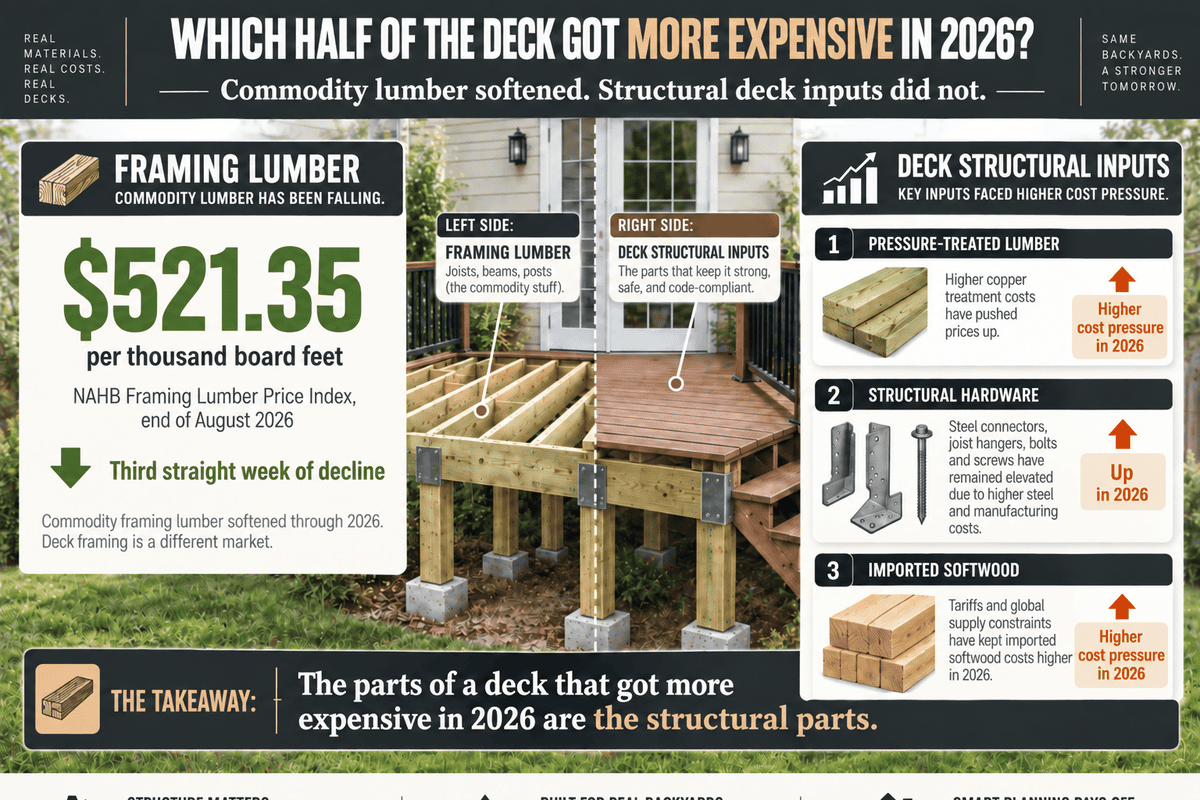
Framing lumber has been falling. The National Association of Home Builders tracks the framing lumber price index weekly. At the end of August 2026 it sat at $521.35 per thousand board feet — the third straight week of decline after nearly three months of rising prices. That's not a crisis number. Anyone telling you commodity lumber is in a panic right now isn't reading the index.
So if raw lumber is soft, why are deck quotes up?
Because a deck isn't framed out of commodity SPF two-by-fours. A deck is framed out of pressure-treated lumber, fastened with galvanized and stainless steel hardware, and increasingly finished with imported or composite surface material. And those three things have been moving in a completely different direction from the lumber index.
Pressure treatment runs on copper. Modern ground-contact preservative systems are copper-based. Copper has carried a 50% Section 232 tariff since August 1, 2025. That cost doesn't show up in a framing lumber index, because it isn't lumber — it's chemistry. It shows up in the price of the exact boards a deck is built from.
Structural hardware runs on steel. Joist hangers, post bases, hurricane ties, structural screws, flashing. Section 232 tariffs on steel, aluminum and copper were modified effective April 6, 2026 to apply 50% to primary metal articles and 25% to derivative articles. Connectors are derivative articles. Hardware is a small line on a quote and a large part of whether a deck is safe.
Imported softwood carries its own layer. A 10% Section 232 tariff on imported softwood timber and lumber took effect October 14, 2025. Average duties on Canadian lumber shipped into the United States rose from 14.38% to 35.19% in summer 2025, and Canadian shipments into the US fell 20–25% from trend levels once the higher duties and the new tariff took hold.
Put those three together and a pattern falls out that almost nobody is saying out loud:
The parts of a deck that got more expensive in 2026 are the structural parts. The frame, the fasteners, the footings — the parts you never see.
Which brings us back to that kitchen table in Christiansburg.
The $9,400 question
The $21,000 quote was a full teardown and rebuild. New footings, new posts, new frame, new hardware, new surface, new rails.
The $11,600 quote kept the frame.
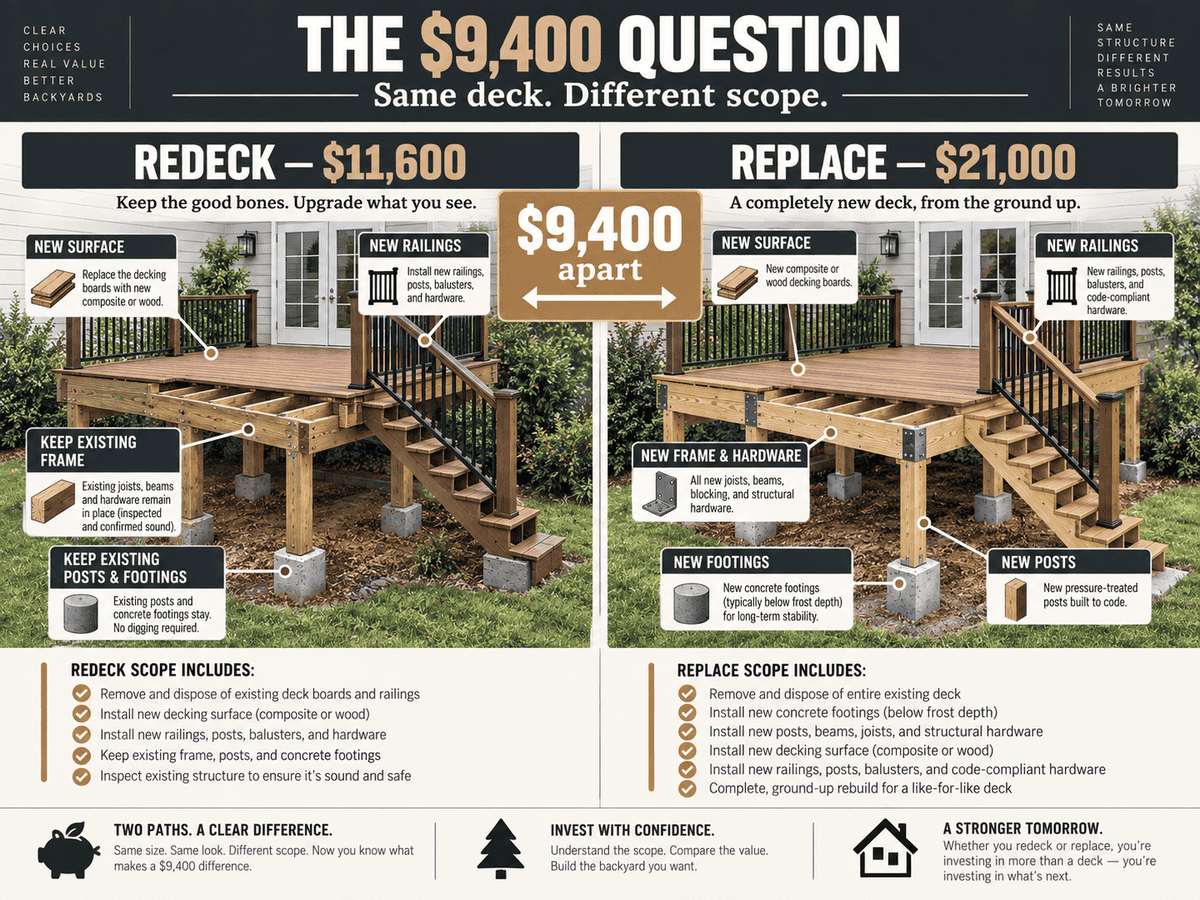
Both contractors looked at the same deck. One of them crawled under it.
That deck was built in the early 2000s with 2x8 joists on 16-inch centers, six-by-six posts on poured footings below frost line, and a properly flashed ledger. The surface boards were finished — cupped, checked, splinters at every fastener, two spots that flexed when you stepped on them. It looked terrible. It looked, honestly, like a teardown.
The structure underneath was sound.
We call this the difference between what a deck looks like and what a deck needs, and it is the single most expensive misunderstanding in this trade. What you see from above tells you almost nothing about what's happening below. A deck can look fine on top and be rotting at the ledger. A deck can look finished on top and have thirty years left in its frame.
There's only one way to find out, and it involves getting under there with a flashlight and an awl.
What makes a frame keepable
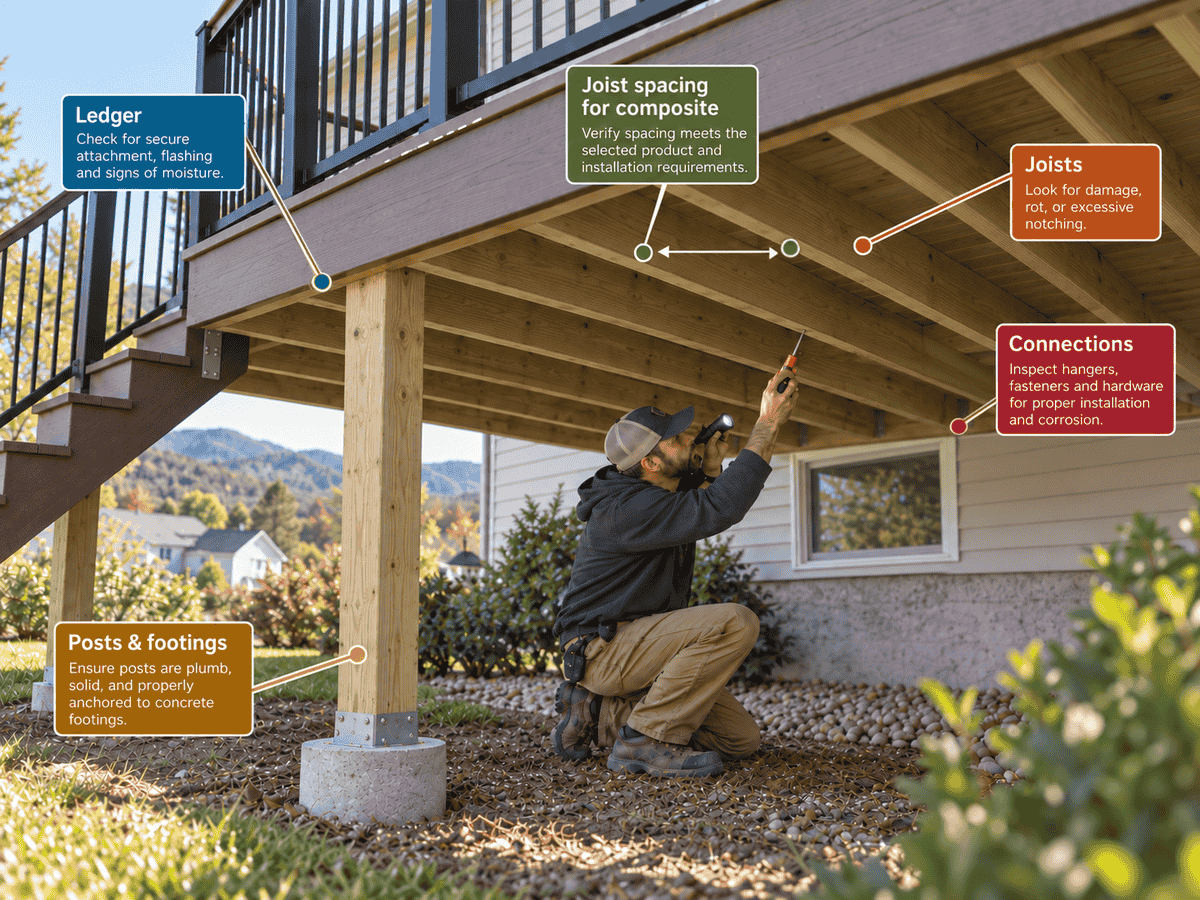
When we do a free RE-Assessment, we're answering one question in five parts. This is the checklist, and you're welcome to use it on your own deck before you call anybody.
The ledger. Where the deck attaches to your house. Is it a minimum 2x8, is it through-bolted rather than nailed, and is it flashed so water sheds away from the band board instead of into it? A failed ledger is the most common way decks come off houses. It is also the one thing that can condemn an otherwise healthy frame.
The posts and footings. Are the posts sitting on a proper concrete footing below the frost line, on an elevated post base that keeps end grain off concrete? Or are they buried in dirt or resting flat in a puddle? Post bases are where rot starts, because that's where water sits.
The joists. Probe them — especially the top edge, where the decking sits. That's the surface that stays wet. Moisture gets trapped between the board and the joist and it doesn't dry, so the rot on a deck frame usually starts on the top of the joist under a board that looks fine.
The connections. Joist hangers at every joist, correct nails in every hole, rated for treated lumber. We use joist hangers on every project because it's the code-compliant connection, and because toe-nailed joists are exactly the kind of thing that passes visual inspection and fails under load.
The spacing, if you want composite. This is the one that surprises people. Composite and PVC boards have different span requirements than wood. A frame built on 16-inch centers for wood may need blocking or added joists before it will carry composite — and it definitely will if you want boards run on a diagonal. That's a real cost, and it's a cost we'll tell you about before you fall in love with a sample board.
Five checks. That's the whole difference between an $11,600 project and a $21,000 project.
RePair. ReDeck. RePlace.
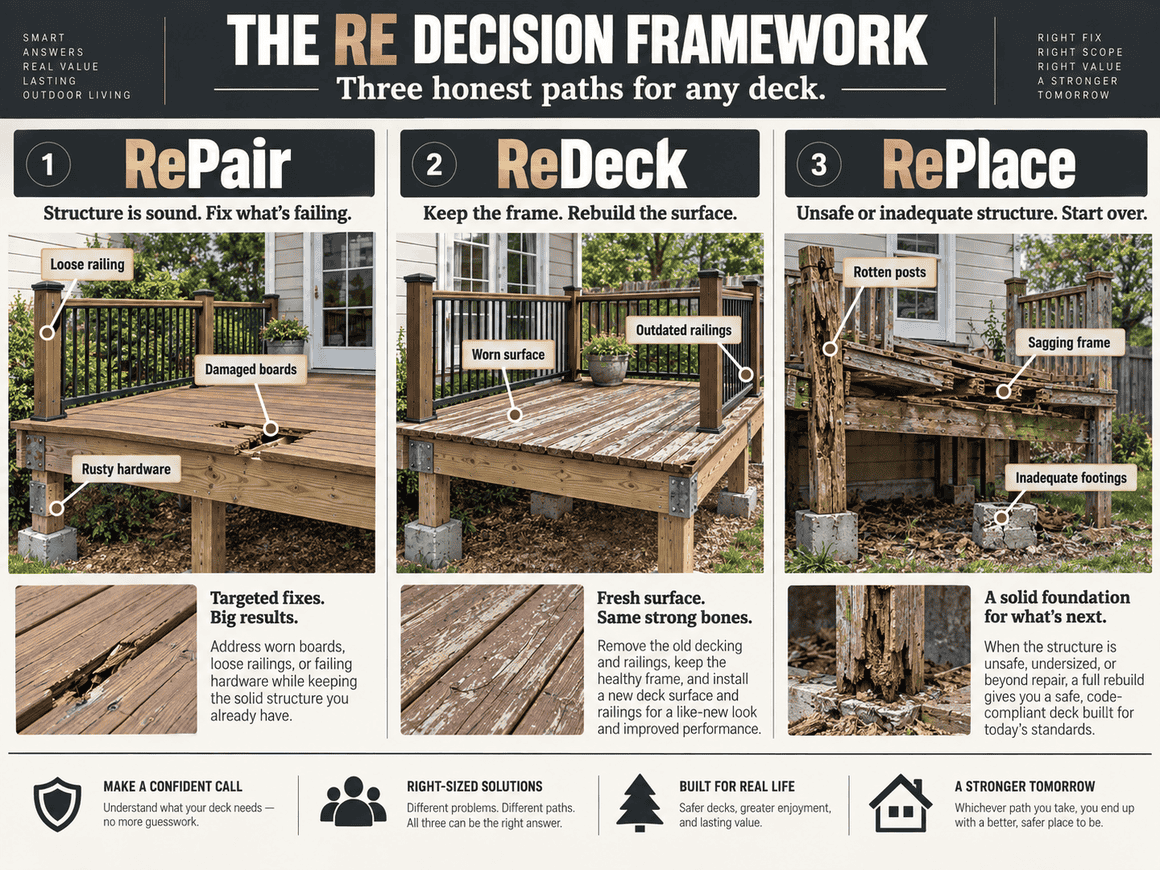
Every deck in Southwest Virginia lands in one of three categories, and the entire job of an honest assessment is telling you which one you're in.
RePair — the structure is sound and the problems are isolated. A few bad boards, a loose rail section, a post base that needs attention. You fix what's failing and you leave the rest alone.
ReDeck — the frame is solid and the surface is finished. We strip the deck down to the structure, correct anything that needs correcting, and rebuild the walking surface and the railings on the bones you already own. This is the option most homeowners don't know exists, and in a year when structural material is the expensive part, it's the option that saves the most.
RePlace — the structure isn't safe to keep. Compromised ledger, rotted posts, undersized framing, footings that were never right. We don't dress up a deck we wouldn't let our own families stand on. When it needs to come down, we say so.
Notice what that framework does not do. It doesn't start from what we'd like to sell. It starts from what's under your deck.
"Doesn't a new deck add more value, though?"
It's a fair question, and there's real data behind it.
Zonda's annual Cost vs. Value report — the trade-standard national study on remodeling returns — put a wood deck addition at $18,263 in cost against $17,323 in resale value, a 94.9% recoup, and a composite deck addition at $25,096 against $22,199, an 88.5% recoup. Those are among the strongest returns of any project in the study, interior or exterior.
Here's the honest reading of that number, though, and it's not the reading most contractors give you.
Those figures are for a deck addition — building outdoor living space where none existed. The resale value is coming from the space itself, not from the fact that the lumber is new. If you already have a 320-square-foot deck and you spend $21,000 replacing it with another 320-square-foot deck, you have not added 320 square feet of outdoor living space to your home. You've bought back the space you already had.
Which means the resale math and the cost math point at the same conclusion: if the structure is sound, the money you'd spend rebuilding it isn't buying you value. It's buying you a frame you already own.
What is your deck actually costing you right now, in the condition it's in — and how much of that is the surface?
What to ask any contractor before you sign
You don't have to take our word for any of this. You just have to ask a few questions, and the answers will sort people out quickly.
- "Did you get under the deck?" Not looked at it. Got under it. If the answer is no, the quote is a guess.
- "What's the condition of the ledger and how is it attached?" A contractor who can't answer this specifically hasn't looked at the thing most likely to hurt you.
- "Which parts of my structure are you keeping, and why?" Every honest rebuild quote can explain what it's discarding.
- "Is my joist spacing rated for the surface material you're quoting?" If you're being quoted composite, this question has a real answer.
- "Is this permitted, and who pulls it?" In Montgomery County, the towns of Christiansburg and Blacksburg issue their own building permits — the county doesn't handle work inside town limits. A contractor working here should know that without looking it up.
If a contractor gets irritated by those five questions, you've learned something useful for free.
Where this leaves you
Material costs in this trade moved in 2026, and they moved unevenly. The commodity lumber everybody quotes in the news got cheaper. The treated lumber, the steel connectors and the imported stock that decks are actually built from did not. The Commerce Department is due to report on the wood tariff program by October 1, 2026, with the possibility of the scope expanding. We don't know which way that goes, and anybody who tells you they do is selling something.
What we do know is this: the structural half of a deck is the half that got more expensive, and the structural half is the half you might already own.
You've probably been telling yourself you'll deal with the deck when it gets bad enough that you can't ignore it. Most people do. It's not a character flaw — it's what happens when you don't know whether you're looking at a four-thousand-dollar problem or a twenty-thousand-dollar problem, and finding out feels like it might commit you to something.
It doesn't. The RE-Assessment is free, it takes about forty-five minutes, and you end it knowing which of the three categories your deck is in and roughly what each path costs.
Would it be unreasonable to find out what you're actually dealing with before you spend a dollar on it?
Call ReDeck Virginia at (540) 585-1720, or request your free RE-Assessment at redeckva.com. We repair, resurface and rebuild decks across Christiansburg, Blacksburg, Radford, Dublin, Pulaski and Salem — and we'll tell you the truth about which one yours needs.
RePair. ReDeck. RePlace.
Frequently asked questions
It comes down to five things: the ledger connection to the house, the condition of the posts and footings, the soundness of the joists (especially the top edge under the decking), whether proper joist hangers are in place, and whether the joist spacing supports the surface material you want. A deck that looks worn on top very often has a frame with years left in it. The only way to know is an under-deck inspection.
Because deck material and commodity framing lumber are two different markets. Framing lumber prices softened through 2026, but pressure-treated lumber carries copper-based preservative costs, structural hardware carries steel costs, and imported softwood carries a 10% Section 232 tariff that took effect in October 2025. Those are the inputs a deck is actually built from.
When the structure is sound, yes — meaningfully. Resurfacing keeps the footings, posts and frame, which is the labor-heavy and now tariff-heavy portion of a deck, and replaces the walking surface and railings. When the structure isn't sound, resurfacing is the wrong answer and we'll tell you so.
In Virginia, incorporated towns issue their own building permits, so work inside Christiansburg or Blacksburg goes through the town, not Montgomery County. Structural deck work generally requires a permit and inspection. We handle permitting as part of the project.
National data from Zonda's Cost vs. Value report shows deck additions recouping 94.9% of cost in wood and 88.5% in composite — among the best returns in remodeling. Worth noting: that data measures adding outdoor living space. Replacing a deck you already have returns differently than adding one you don't.
About ReDeck Virginia
ReDeck Virginia is a Class A licensed, insured deck specialist based in Christiansburg, VA, serving homeowners across the New River Valley and SW Virginia. We repair, resurface (ReDeck), and rebuild decks — and we always start by telling you the truth about what yours actually needs.