
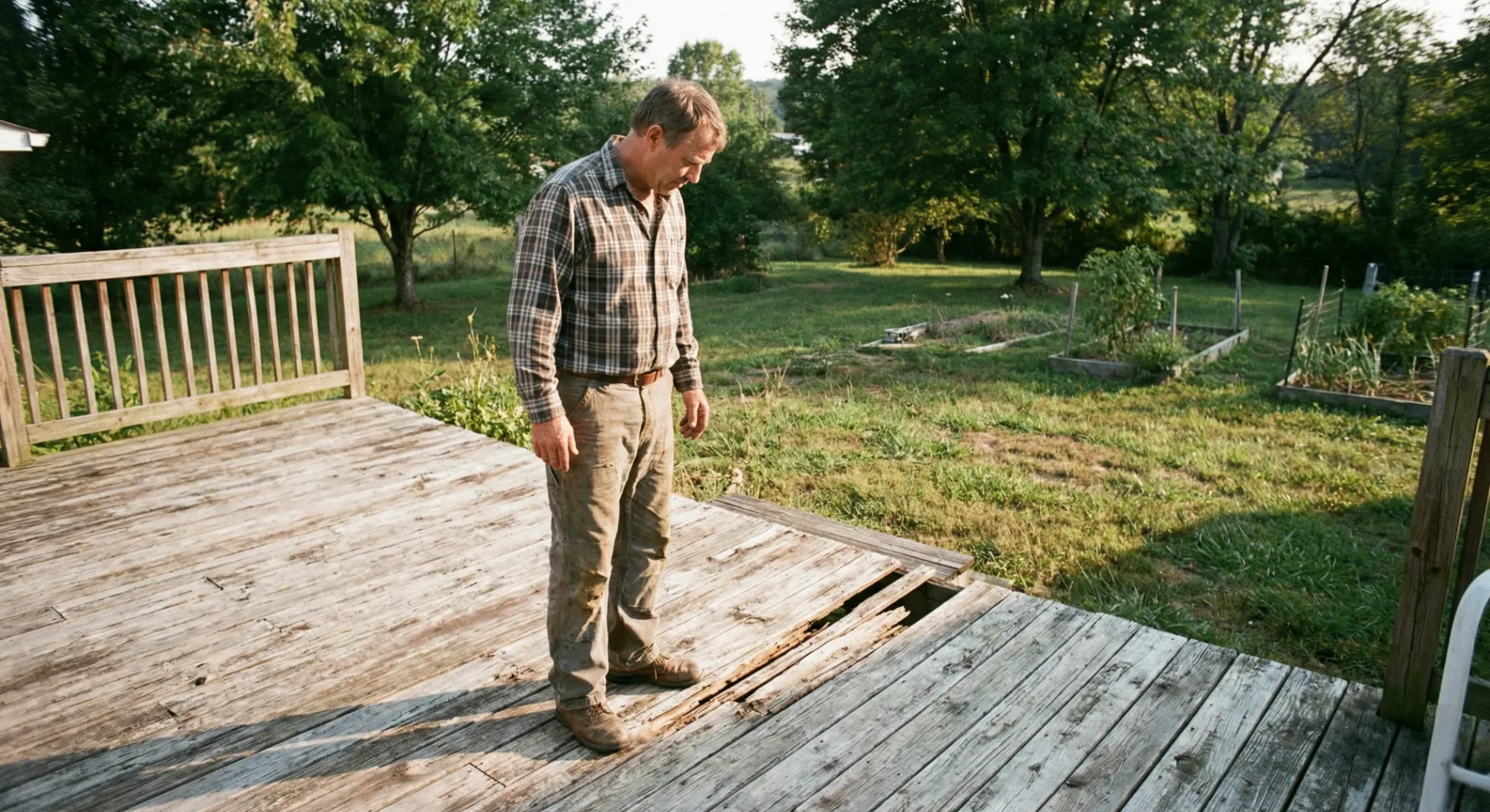
You're standing on your deck and something doesn't feel right.
Maybe it's a soft spot near the sliding door. Maybe the railing moves when you lean on it. Maybe the boards look so rough you're embarrassed when people come over. Or maybe your kid was running across it last weekend and you thought — I should probably deal with this before someone gets hurt.
So you start Googling. And immediately you're drowning in two options: repair it or replace it. As if every deck on earth falls neatly into one of two boxes.
Here's what most contractors won't tell you: there's a third option that saves most homeowners thousands of dollars. And whether you need option one, two, or three depends entirely on what's happening underneath your deck — not what's happening on top of it.
This guide will help you figure out which one you actually need. No pressure. No upselling. Just the truth about your deck.
TL;DR — Key Takeaways
- Most decks don't need to be fully replaced. The framing is often still solid — it's the surface that's failing.
- The RE Decision gives you three paths, not two: RePair (fix what's broken), ReDeck (resurface on solid framing), or RePlace (rebuild when the structure can't be saved).
- The answer is always underneath. What your deck looks like on top tells you almost nothing about what it actually needs.
- Small problems don't stay small. Moisture trapped under failing boards accelerates rot underneath — turning a $2,000 repair into a $15,000 rebuild.
- A free onsite assessment from ReDeck Virginia gives you the answer — not a sales pitch.
Table of Contents
1. Stop Thinking in Two Options
Here's the question that changes everything: what problem are you actually trying to solve?
Most homeowners aren't searching "deck repair vs replace" because they love weekend projects. They're trying to solve something that's been bothering them:
- Safety — wobble, bounce, loose railings, stairs that don't feel stable
- Comfort — splinters, uneven boards, a surface too rough to walk on barefoot
- Appearance — weathered, gray, warped boards that make the whole house look tired
- Rot concerns — soft spots, discoloration near posts, boards that give when you push
- Resale anxiety — a buyer is going to see this, and you know it
The internet tells you to either patch it up or tear it down. But the fastest way to get unstuck is to use a framework most homeowners have never heard of — one that includes a third option that sits right between repair and replace.
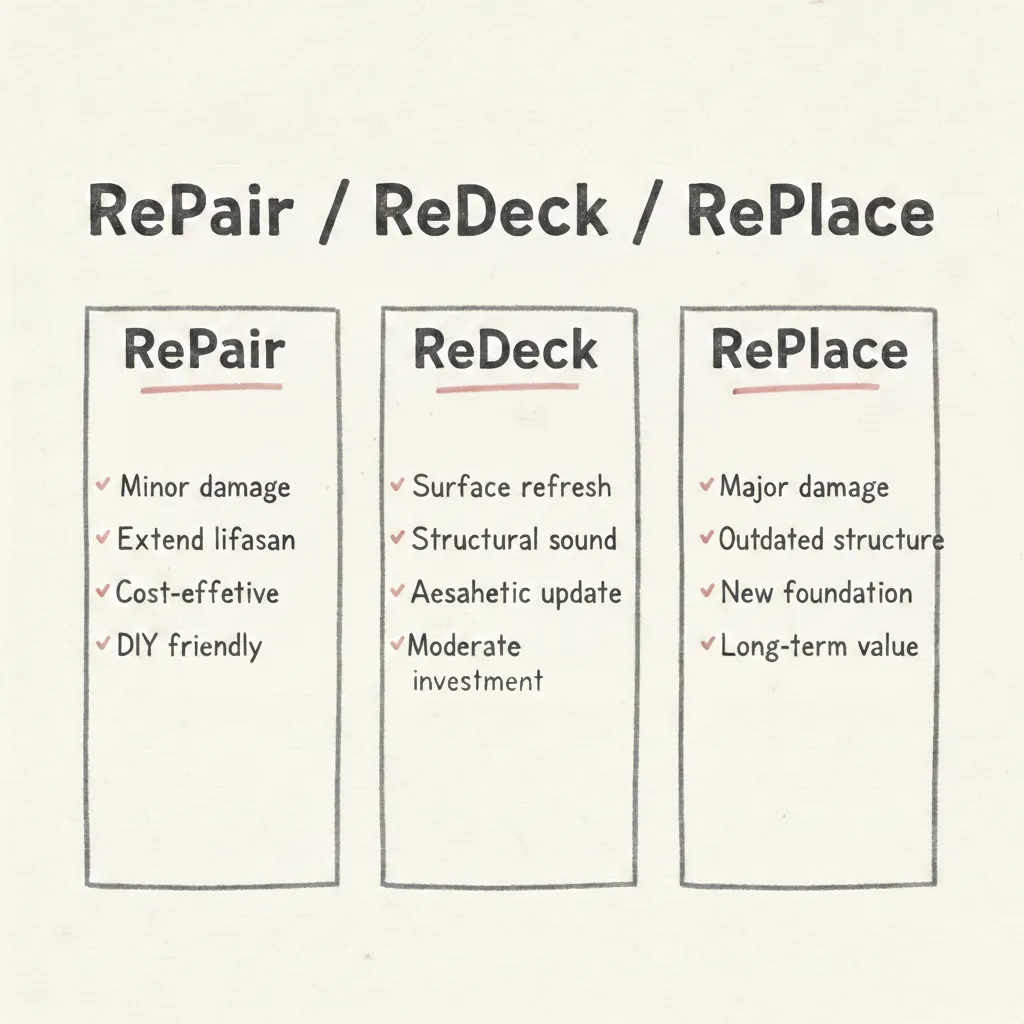
2. The RE Decision Framework: RePair / ReDeck / RePlace
At ReDeck Virginia, we use the RE Decision Framework because it keeps the conversation honest. Instead of two extremes, you get three clear paths — and the right one depends on what's actually going on with your deck's structure.
RePair — Fix What's Failing
Best when: The structure is sound and the problems are isolated.
A few boards are soft. A railing section wobbles. One set of stairs feels sketchy. But the rest of the deck? Solid. In cases like this, a targeted repair handles the problem without touching what doesn't need to be touched.
What drives the scope: how many separate areas are failing, and whether anything underneath those areas is compromised.
→ Learn more about deck repair
ReDeck — Resurface the Deck
Best when: The frame is still solid, but the walking surface and everything you touch has worn out.
This is the option most homeowners don't know exists — and it's the one that saves thousands. If your framing is structurally safe, we strip the old surface and replace it. New boards, new railings, new feel. The deck that made you cringe becomes the deck you want to show off.
What drives the scope: the condition of what's underneath. Resurfacing only makes sense if the structure is safe to keep — which is why we always inspect the framing before we quote the surface.
→ Learn more about ReDecking (resurfacing)
RePlace — Rebuild From the Ground Up
Best when: The structure isn't safe to keep, or fixing it would be a patchwork that won't last.
Sometimes the honest answer is: this deck needs to come down. When there's widespread structural damage — not just ugly boards on top, but compromised framing, failing supports, or foundation problems — rebuilding is the responsible path. We build replacements as freestanding structures with proper footings, and we do it right the first time.
What drives the scope: structural condition and how the deck is currently supported or attached to the house.
→ Learn more about new deck builds
"When the deck began to pull away from my house, I had no idea how to repair it or how much it would cost. I asked for bids from four different companies. One company didn't even answer my request. ReDeck Virginia was responsive, professional, and delivered excellent work."
— Karen Finch, Blacksburg
3. What Can Actually Be Saved (And What Can't)
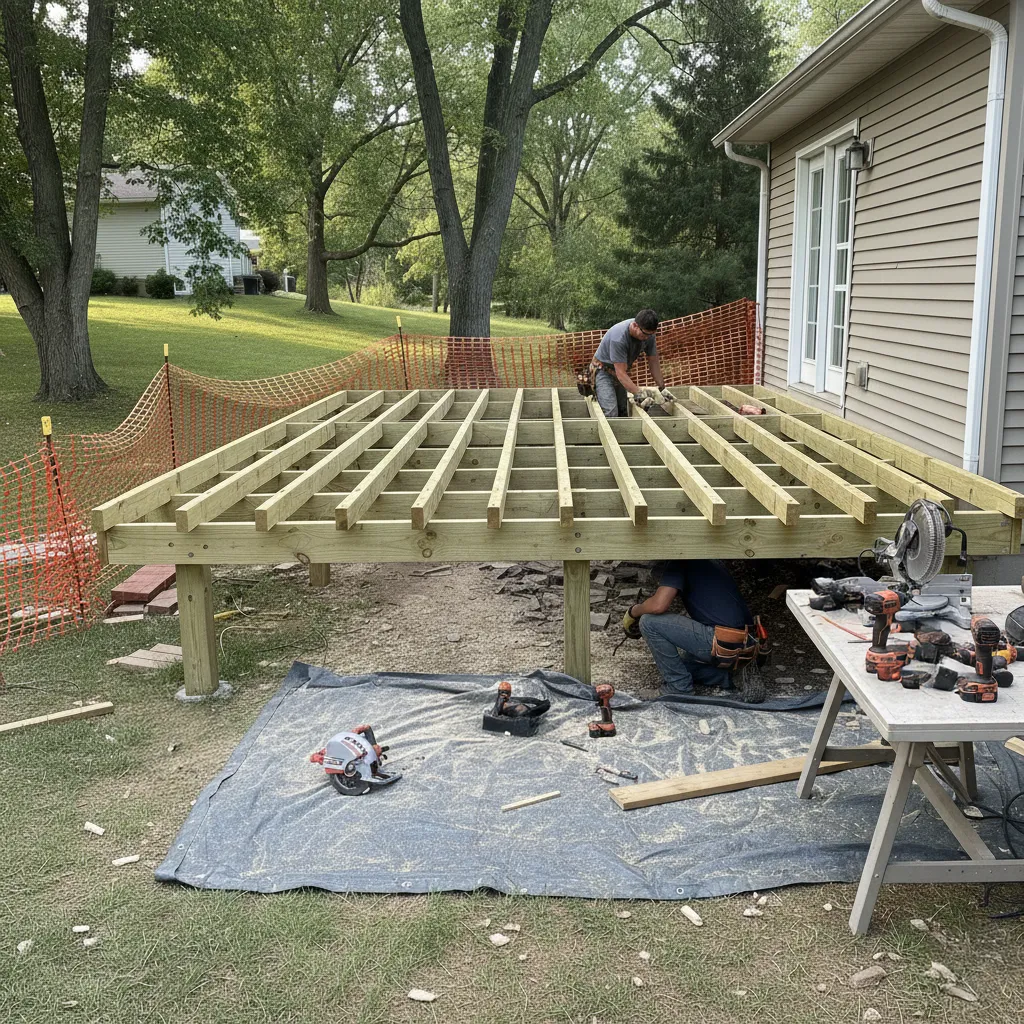
You can only resurface a deck if the structure underneath is worth saving. That means looking past the boards you walk on and examining what holds everything up.
A deck frame can often be saved if it's structurally sound and not deteriorating where it counts. The decision almost always comes down to four things:
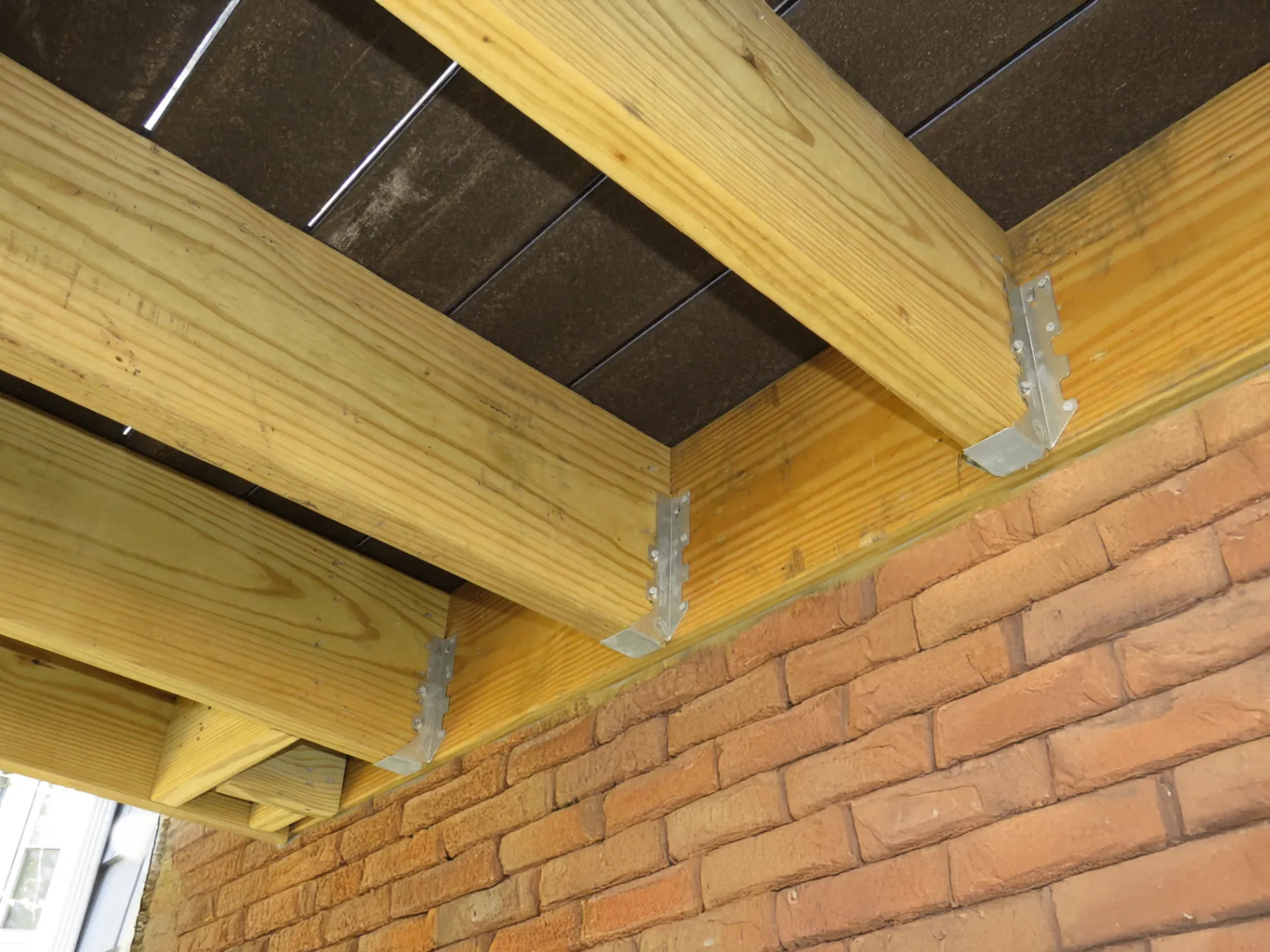
Joists
The horizontal framing members that support your deck boards. If they're solid, straight, and properly connected, that's the foundation of a good ReDeck. We always install joists with joist hangers — it's a consistent, code-compliant method that we trust more than shortcut fastening.
Posts
The vertical supports holding everything up. We look for rot, especially near ground level where moisture concentrates.
Footings
What's under the posts, underground. Proper footings go below the frost line and provide a stable base. Shallow or missing footings can mean the whole structure is compromised — no matter how good the boards look on top.
Attachment Approach
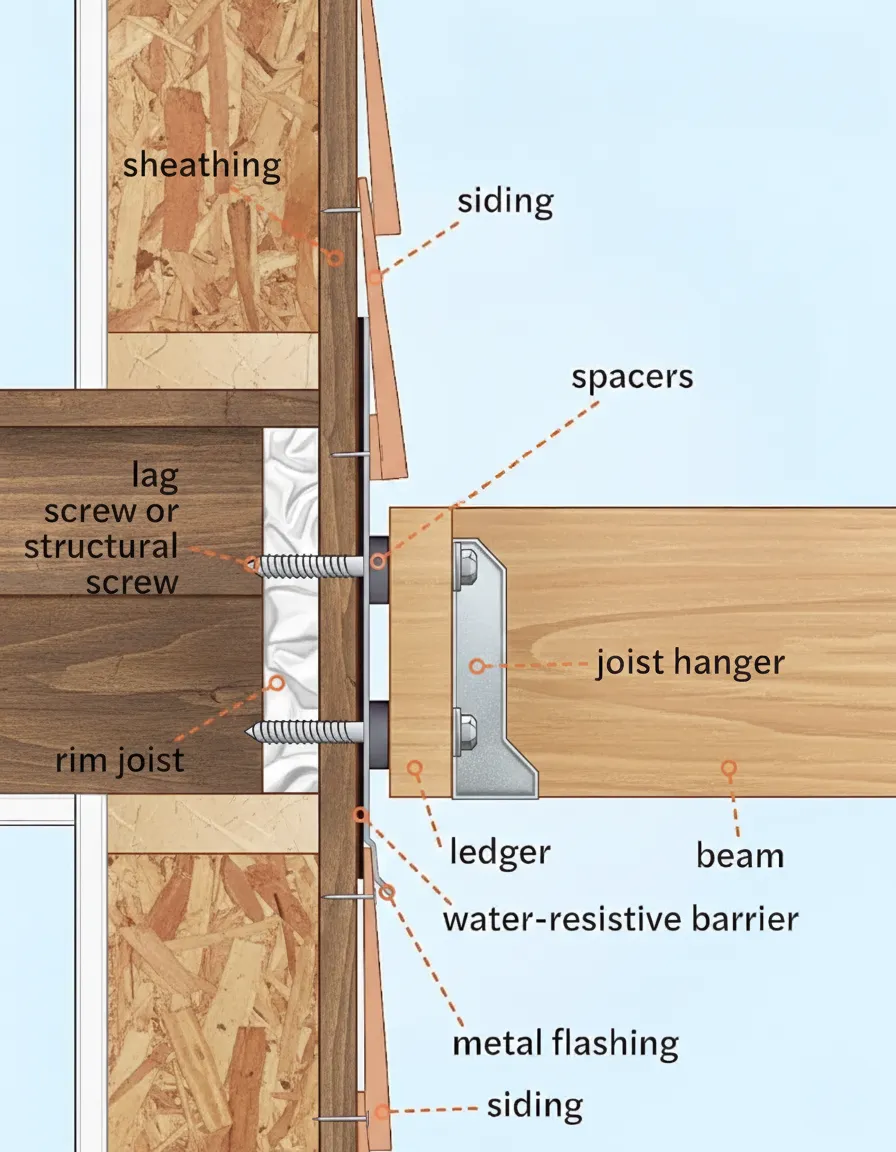
How is the deck connected to your house? A freestanding deck sits on its own footings. A ledger-attached deck bolts to the house's rim joist. Both can work — but a ledger-attached deck needs proper flashing, lag bolts, and tension ties to be safe. When we rebuild, we typically go freestanding. When we work with existing ledger-attached decks, we follow code to the letter: metal flashing, 1/2" lag bolts, and tension ties.
The Quiet Difference-Maker: Keeping Wood Off Concrete
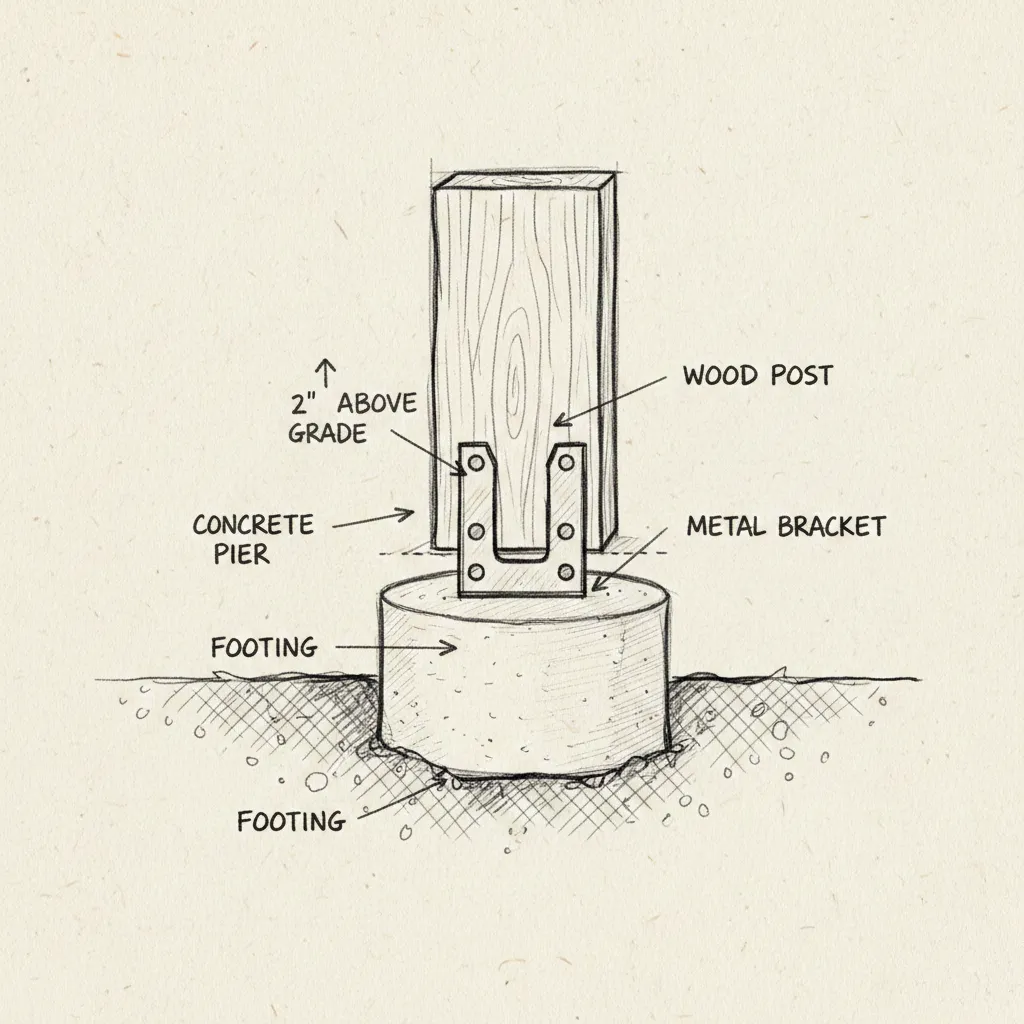
Here's something most homeowners never think about — and most contractors skip. A huge amount of post rot happens right at ground level, where the wood meets the concrete meets the soil.
Our standard approach:
- 2' × 2' footings, typically about 24" deep
- A concrete pier that rises about 2" above grade — so the wood never sits in the splash zone
- A Simpson Strong-Tie bracket that lifts the wood post off the concrete entirely
This keeps the post dry where it matters most. It's not flashy. You'll never see it once the deck is finished. But it's the reason our structures last.
Not sure what your deck needs? Stop guessing.
We'll come look at it, tell you the truth, and give you a clear plan — free.
Request a Free RE-Assessment →4. Red Flags That Usually Mean RePlace
No drama — just reality. If you're seeing any of these, replacement often becomes the only responsible call:
- Widespread rot in the framing — not just a couple of soft boards on top, but decay in the joists, beams, or ledger
- Movement or instability when you walk — the deck shifts, bounces, or sways in ways that suggest a structural support problem
- Sinking, shifting, or cracked footings — the foundation is compromised, and everything above it is at risk
- A structure that can't be corrected without rebuilding key elements — when "fixing" it means replacing so much framing that you're essentially rebuilding anyway
The hardest thing to hear is "this can't be saved." But the hardest thing to live with is a patched deck that fails again in two years. We'd rather tell you the truth now than take your money for a band-aid.
5. What an Honest Contractor Checks On Site
A real inspection isn't a sales pitch. It's a methodical look at what matters — and it's what separates a contractor who's diagnosing from one who's selling.
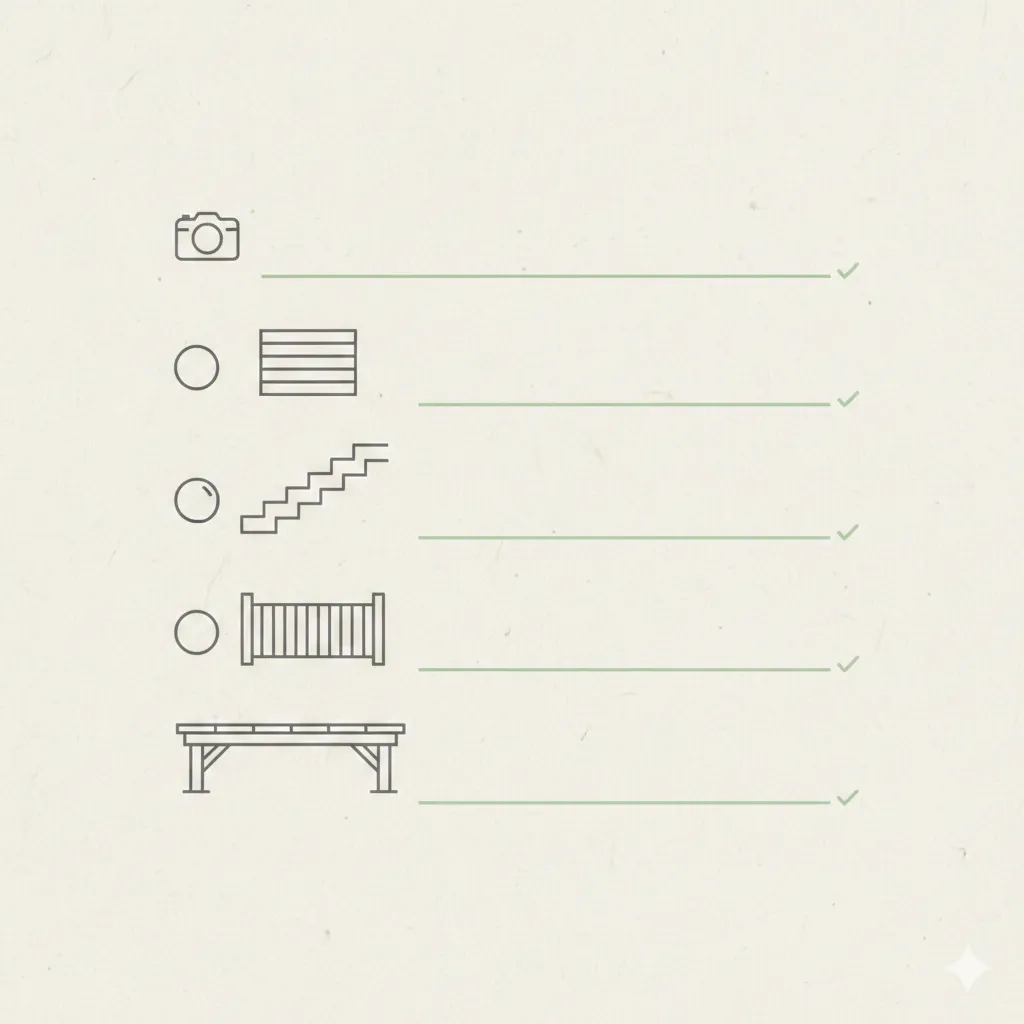
Here's what we check on every assessment:
- 1Attachment approach: Freestanding or ledger-attached? If ledger, is the flashing correct? Are the fasteners structural-grade?
- 2Joists and framing: Are joists properly supported and secured? Are connections consistent? Are joist hangers present?
- 3Footings and post bases: Are footings below the frost line? Are posts lifted off concrete? Is the base connection solid?
- 4Permits and inspections: Was the deck built with a permit? Has it been inspected? We handle the permitting process for every project — including in Blacksburg, which can be trickier for permits than surrounding areas. We've built a strong working relationship there.
6. Three Real Scenarios
Scenario A: RePair
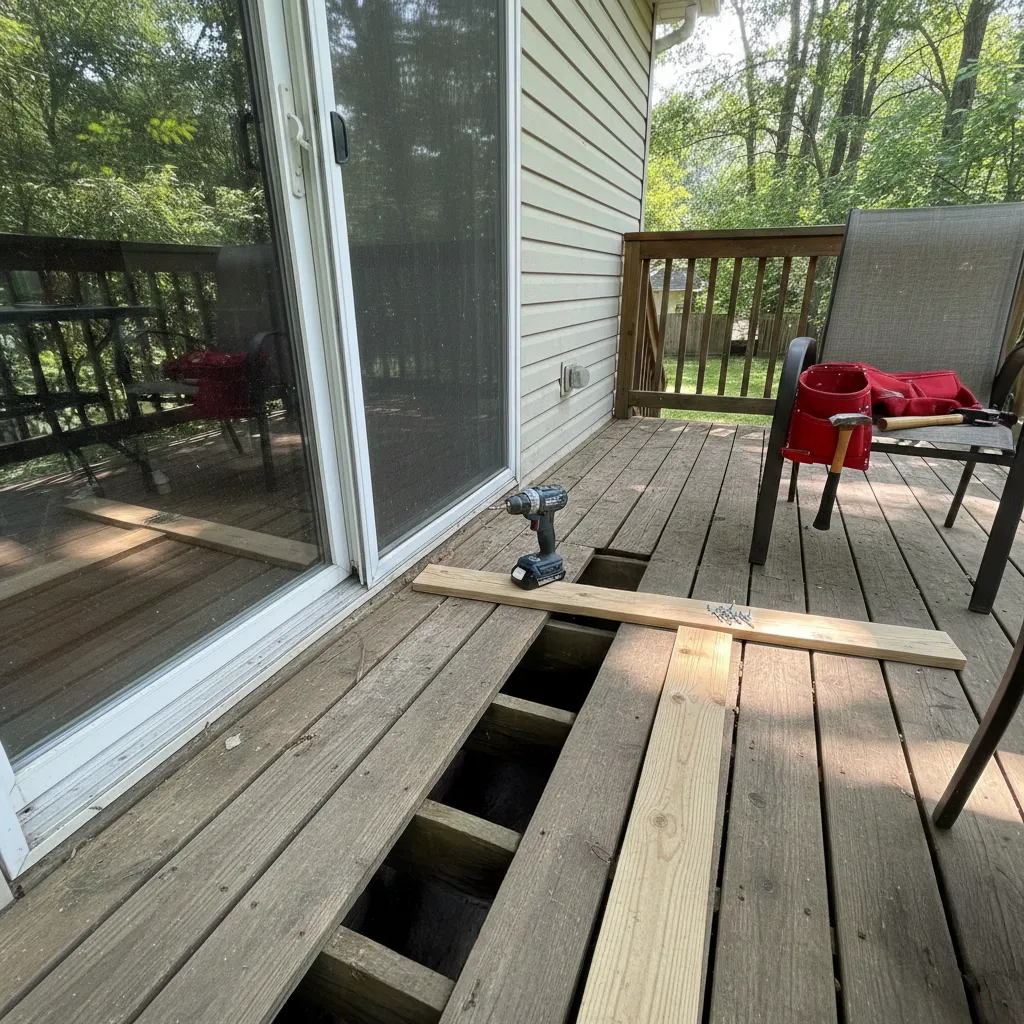
You notice one or two problem areas — a soft section near the stairs, a railing that's loose. The rest of the deck is solid. Fixing those specific areas restores safety and comfort without overbuilding. You're back to enjoying it.
Scenario B: ReDeck
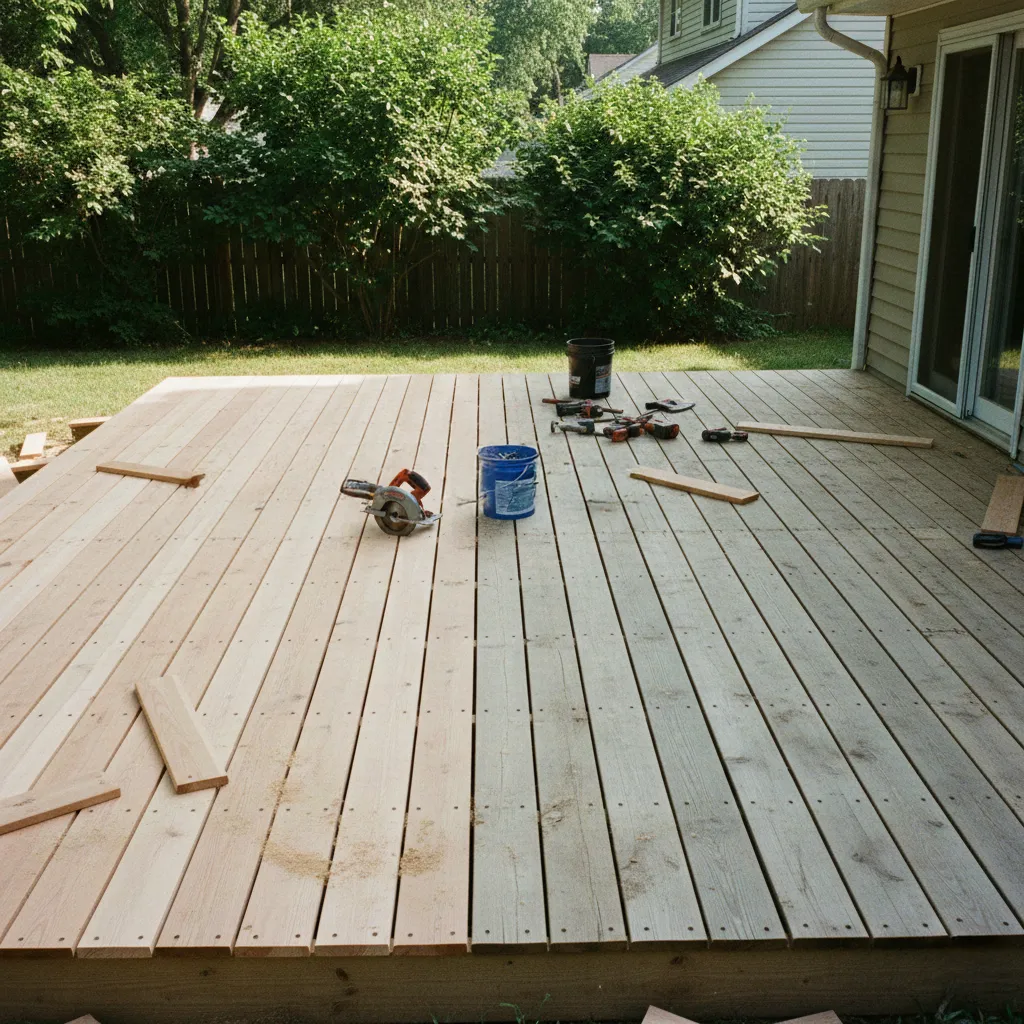
The deck works, but it's worn out everywhere. Rough boards, faded color, dated railings. You go underneath and the framing looks solid — no rot, no movement, connections are good. Resurfacing gives the biggest transformation for the least cost. New surface, new feel, same solid frame.
Scenario C: RePlace
Multiple warning signs — instability when you walk, visible rot in the framing, footings that have shifted. The structure isn't worth saving safely. Rebuilding from the ground up — with proper footings, freestanding structure, and code-compliant everything — is the clean, long-term answer.
FAQ
Yes. We come to you, inspect the deck, and give you a straight answer — RePair, ReDeck, or RePlace. No cost, no obligation.
Yes. We handle the full permitting process, including in Blacksburg where permitting can be more involved.
Rebuilds are typically freestanding. If a deck is ledger-attached, we follow code-guided methods including metal flashing, 1/2" lag bolts, and tension ties.
Yes — on every project. It's a non-negotiable for us.
2' × 2' footings about 24" deep, with a concrete pier approximately 2" above grade and a Simpson Strong-Tie bracket that lifts the wood post off the concrete to keep it dry.
We serve Christiansburg, Blacksburg, Radford, Dublin, Pulaski, Salem, and surrounding SW Virginia communities.
Yes — we provide a 1-year workmanship warranty on installation and help customers register applicable product warranties.
Get the Right Answer for Your Deck
If you're in Southwest Virginia and you're not sure whether your deck needs a repair, a resurface, or a rebuild — the fastest way to find out is to let us look at it.
We'll tell you what can be saved. We'll tell you what can't. And we'll give you a clear plan with honest numbers — so you can make the right call for your home, your family, and your budget.
No guessing. No pressure. Just the truth about your deck.
About ReDeck Virginia
ReDeck Virginia is a licensed, insured, veteran-owned deck specialist based in Christiansburg, VA, serving homeowners across the New River Valley. We repair, resurface (ReDeck), and rebuild decks — and we always start by telling you the truth about what yours actually needs.
Learn more about us →