

It's Memorial Day weekend. The grill is going. Your kids are running across the deck. Your in-laws are leaning on the railing watching the sunset over the ridge. Twelve people, maybe fourteen, all on the same back deck — the one you've been meaning to look at since last fall.
That's the moment most homeowners realize they don't actually know if their deck is safe.
Not in a panic-attack kind of way. In a quiet kind of way. The kind where you glance over at the corner where the railing wobbles a little and you think, I should probably get that checked sometime.
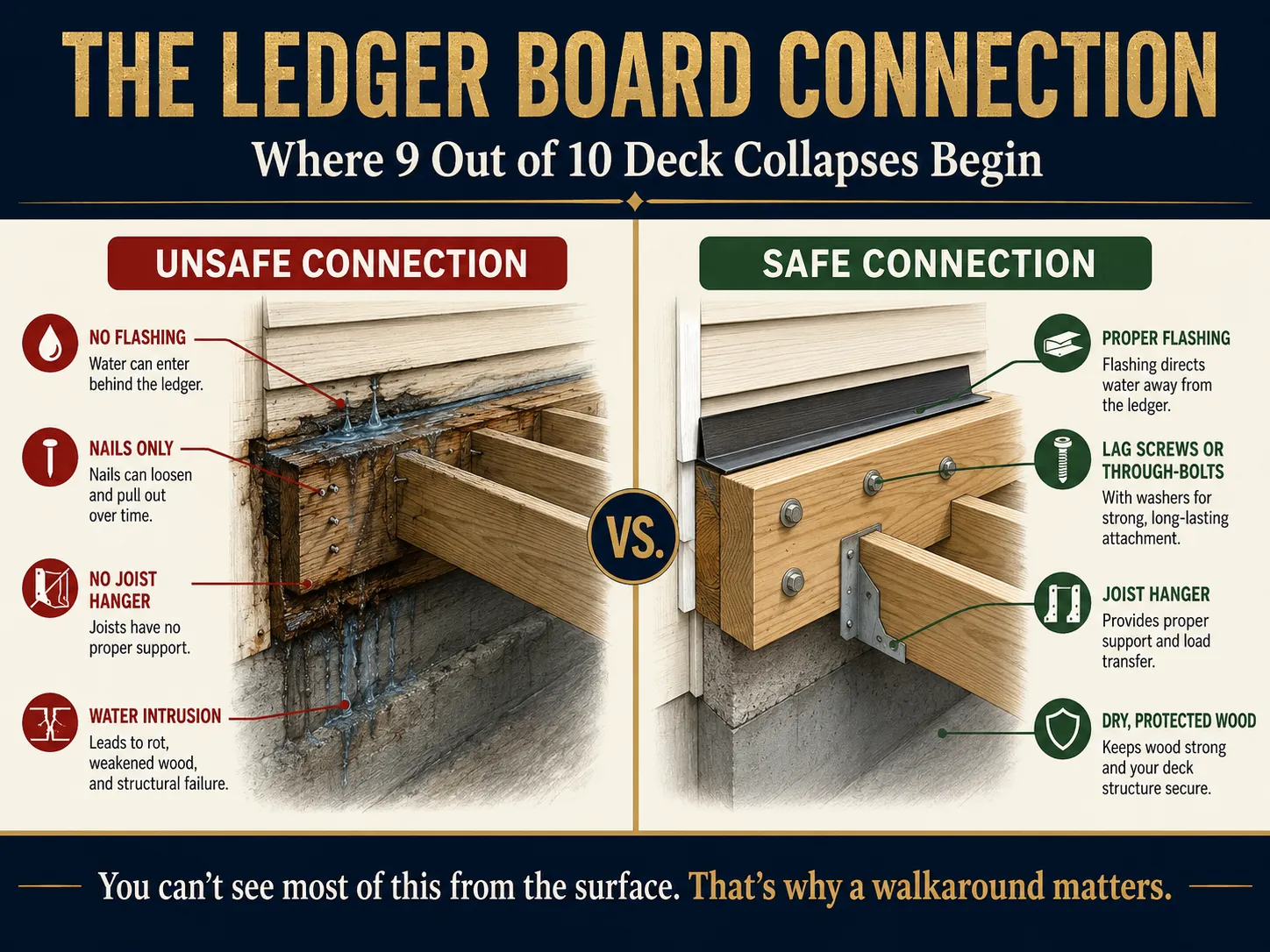
Here's the truth nobody likes to say out loud: about 90% of deck collapses start at one specific spot — the ledger board, where your deck attaches to your house. And almost every one of them happens during normal use. A cookout. A graduation party. A Sunday afternoon. According to data tracked by the International Association of Certified Home Inspectors, roughly 6,000 people are injured every year in the U.S. by deck, porch, and balcony failures — and about 1 in 5 of those injuries puts someone in the hospital.
You're not being paranoid. Your gut is doing exactly what it's supposed to do.
TL;DR — What This Post Will Tell You
- May is national Deck Safety Month — the time of year experts recommend you actually check your deck instead of assuming it's fine.
- Most deck failures don't start where you'd look — they start at the ledger, the post bases, or the hardware you can't see from the surface.
- You can do a 10-point walkaround in about 20 minutes — no tools, no expertise required.
- One issue isn't a crisis. Multiple issues are a pattern — and patterns mean it's time to bring someone in.
- A free onsite safety check tells you exactly what's going on — without the sales pitch most contractors lead with.
Table of Contents
1. Why "It Looks Fine" Isn't an Inspection
Let's start with the conversation most contractors won't have with you.
You might be thinking we're trying to scare you into a sales call. You might be thinking, "My deck is fine. I'd know if something was wrong." You might be thinking the only people who actually need to worry about deck safety are the ones with obviously rotting boards.
That would be a fair thing to think — except it's not how decks fail.
Decks fail from the inside out. The boards on top are the part that gets the sun, the rain, the foot traffic — the part that looks worn. But the part that actually holds the deck up — the framing underneath, the ledger attached to your house, the post bases sitting in the dirt — that's the part that's been quietly absorbing moisture, loosening at the connections, and getting weaker every freeze-thaw cycle since 2009.
Most decks in SW Virginia were built before modern hardware codes. That's not a criticism of whoever built them. It's just the truth about timing. If your deck went up before about 2009, the chances are decent that it was attached with nails alone instead of structural-grade lag screws or through-bolts — and a nail-only ledger connection is the single most common cause of deck collapse in America.
You wouldn't know that from looking at it. That's the whole problem.
What experts call "Deck Safety Month" exists for one reason: the North American Deck and Railing Association estimates that of the 60+ million decks in the U.S., over 30 million are past their useful service life. That's not a marketing number. That's an industry consensus. And the reason May is the chosen month is simple — it's right before peak deck use, and a 20-minute check now beats a 911 call in July.
2. The 10-Point Deck Safety Check
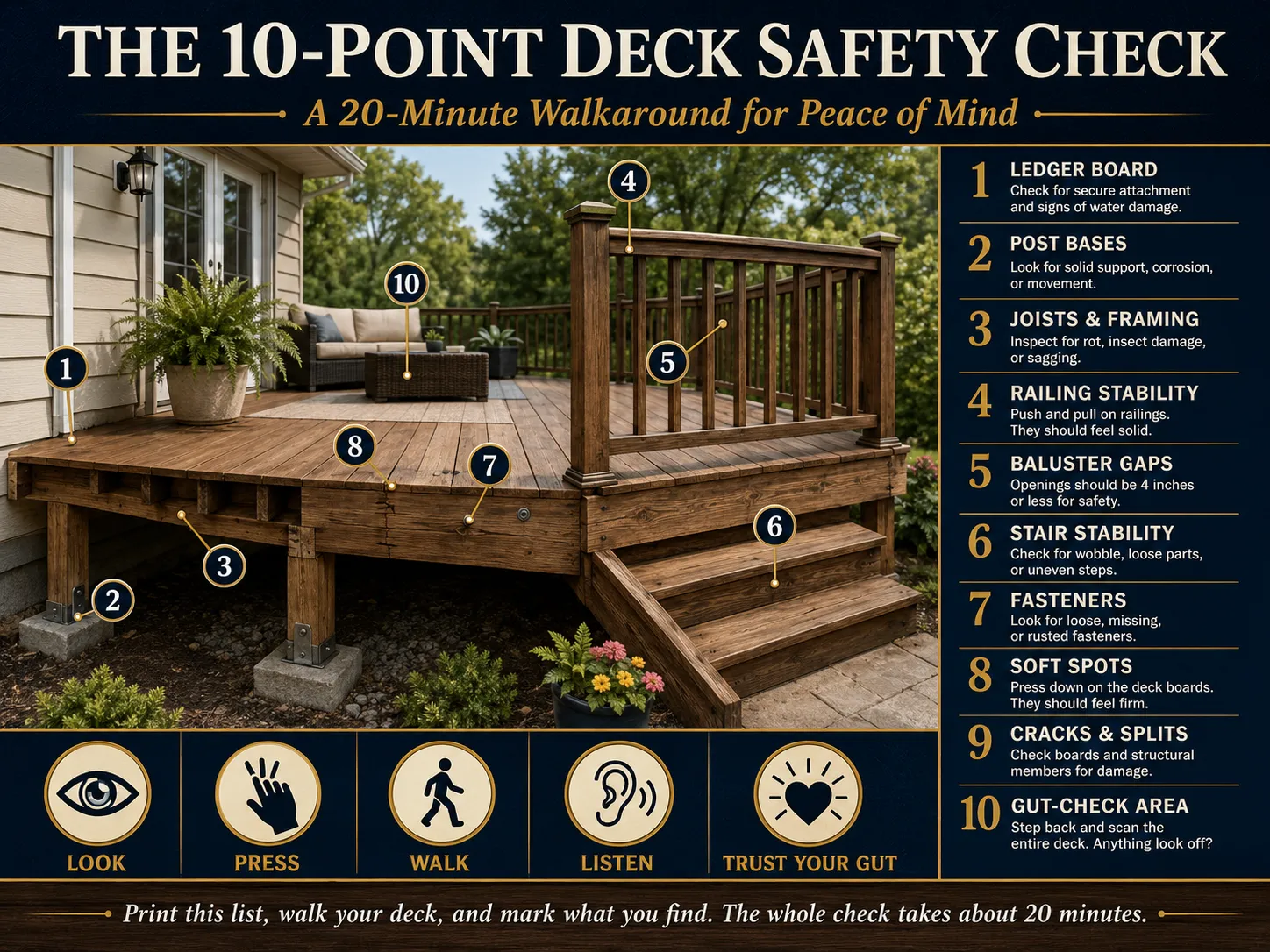
Here's the walkaround. Twenty minutes. No ladder, no tools, no contractor required for this part. Just you, your deck, and honest answers.
If something on this list makes you uncertain — that's not a failure. That's the list working. Mark it, move on, and we'll talk about what to do at the end.
- 1The ledger board (where the deck meets the house). Walk to the spot where the deck connects to your house. Look at the board running along the wall — that's the ledger. Are you seeing nail heads only, or are you seeing bolts and lag screws with washers? If you only see nails, that's a serious safety flag. Also check for flashing — a metal strip that should be tucked between the ledger and the house siding, directing water away. Missing or rusted flashing means water has been sitting against that board for years.
- 2Post bases. Look at where the support posts meet the ground or the concrete pads underneath. Do the posts sit directly on the dirt or directly on concrete with no metal bracket? If yes, that post has been wicking moisture for as long as the deck has existed. Press a screwdriver into the bottom 6 inches of each post. If it sinks in more than ⅛ of an inch with light pressure, that post is rotted.
- 3Joists and framing (the boards under your deck boards). This is where you have to crouch down or, if your deck is high enough, look from below. Are the joists discolored, cracked, or do you see fungus or mushroom growth? Are there visible metal joist hangers connecting them to the ledger and the beams, or are they toenailed in with nails? Hangers are required by modern code. Toenails alone aren't safe.
- 4Railing stability. Push on the top rail at every post — corners, mid-span, near the stairs. Does it move more than a quarter-inch? Does the post itself rock at the base? Railings are designed to hold 200 pounds of horizontal force at the top. If a child can shake it, it can't.
- 5Baluster and spindle gaps. Stand back and look at the spaces between the vertical pieces in the railing. Can a 4-inch sphere fit between any two of them? That's the code minimum, and it exists because that's the point a small child's body can fit through. If yours has bigger gaps, especially at corners or near stairs, that's not a code violation — that's a child-safety hazard.
- 6Stair stability. Walk up and down the stairs slowly. Do they bounce, shift, or feel like they're moving independently from the deck? Look at the stringers (the angled boards that hold the steps up) — are they cracked, are the steps pulling away from them? Is there a handrail you can grip on the way down? If not, code requires one.
- 7Fasteners — the nails and screws holding the boards down. Walk the surface and look for popped nails, rust streaks running down the boards, or screws that are sitting proud of the surface. Rust streaks mean the metal is corroding inside the wood, and corroded fasteners lose holding power. A popped nail isn't just a tripping hazard — it's a sign the wood is shrinking, swelling, and pulling away from the frame.
- 8Soft spots underfoot. Walk every square foot of the deck. Do any spots feel spongy, bouncy, or softer than the rest? That's almost always rot underneath the surface. Pay extra attention to the areas around posts, near downspouts, and anywhere two boards meet — those are the moisture traps.
- 9Cracks, splits, and splinters. Hairline checks in the surface are normal weathering. Long cracks running with the grain — especially through joists, beams, or posts — are not. A crack longer than 6 inches in a structural piece is a structural concern, full stop.
- 10The "does anything feel wrong" check. Stand on your deck. Take a slow breath. Has there been a place you stopped walking? A spot you tell visitors to avoid? A railing you've stopped leaning on? If your body has been quietly avoiding part of your own deck, your nervous system has already done the inspection. You're just catching up.
A Quick, Honest Question
How many of those did you have to think about?
Not the ones where the answer was an obvious yes. The ones where you said, "...I'm not actually sure."
That number is the one that matters.
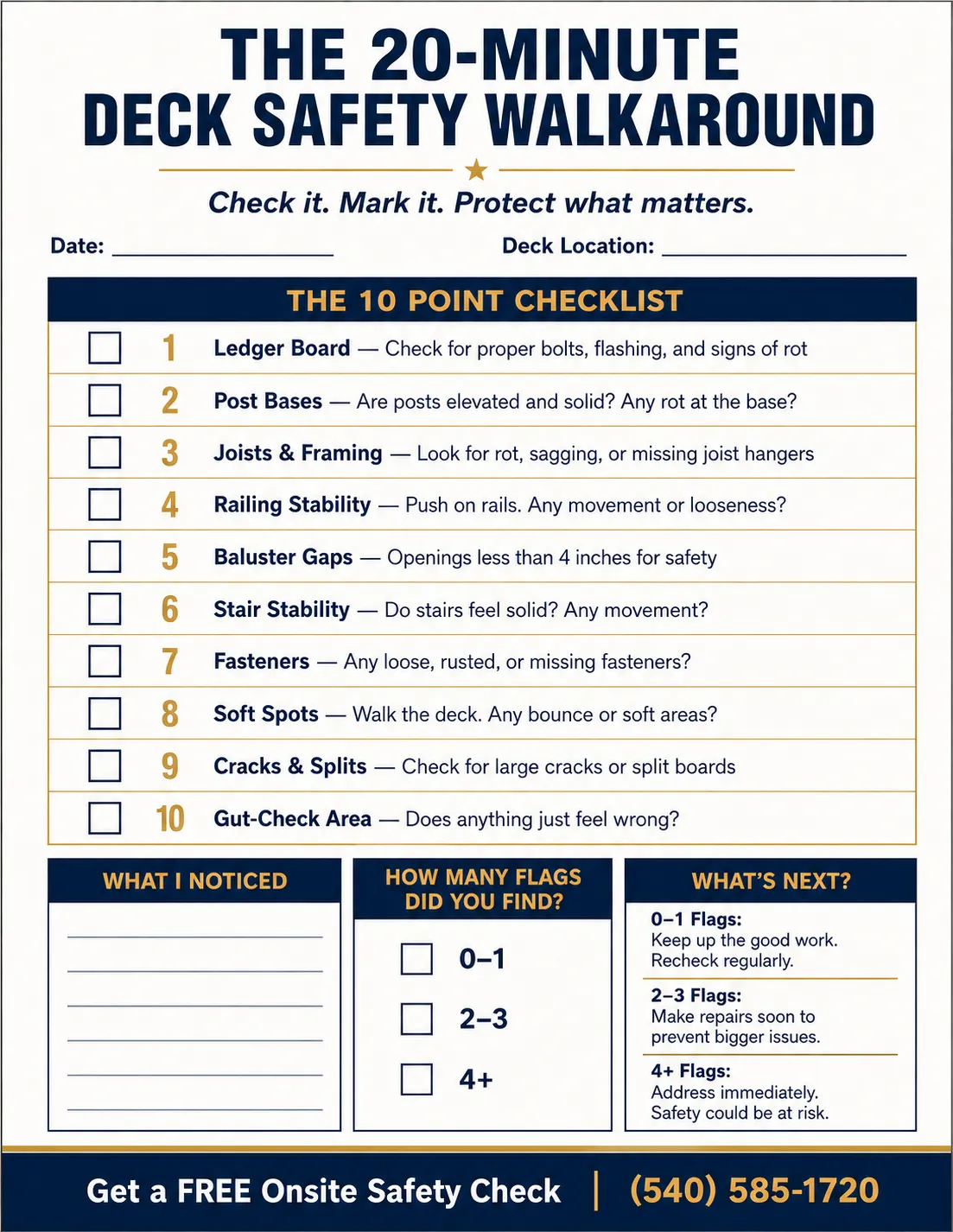
Want to make the walkaround easier? Save or print this checklist before you step outside.
3. What Each Failure Point Actually Means
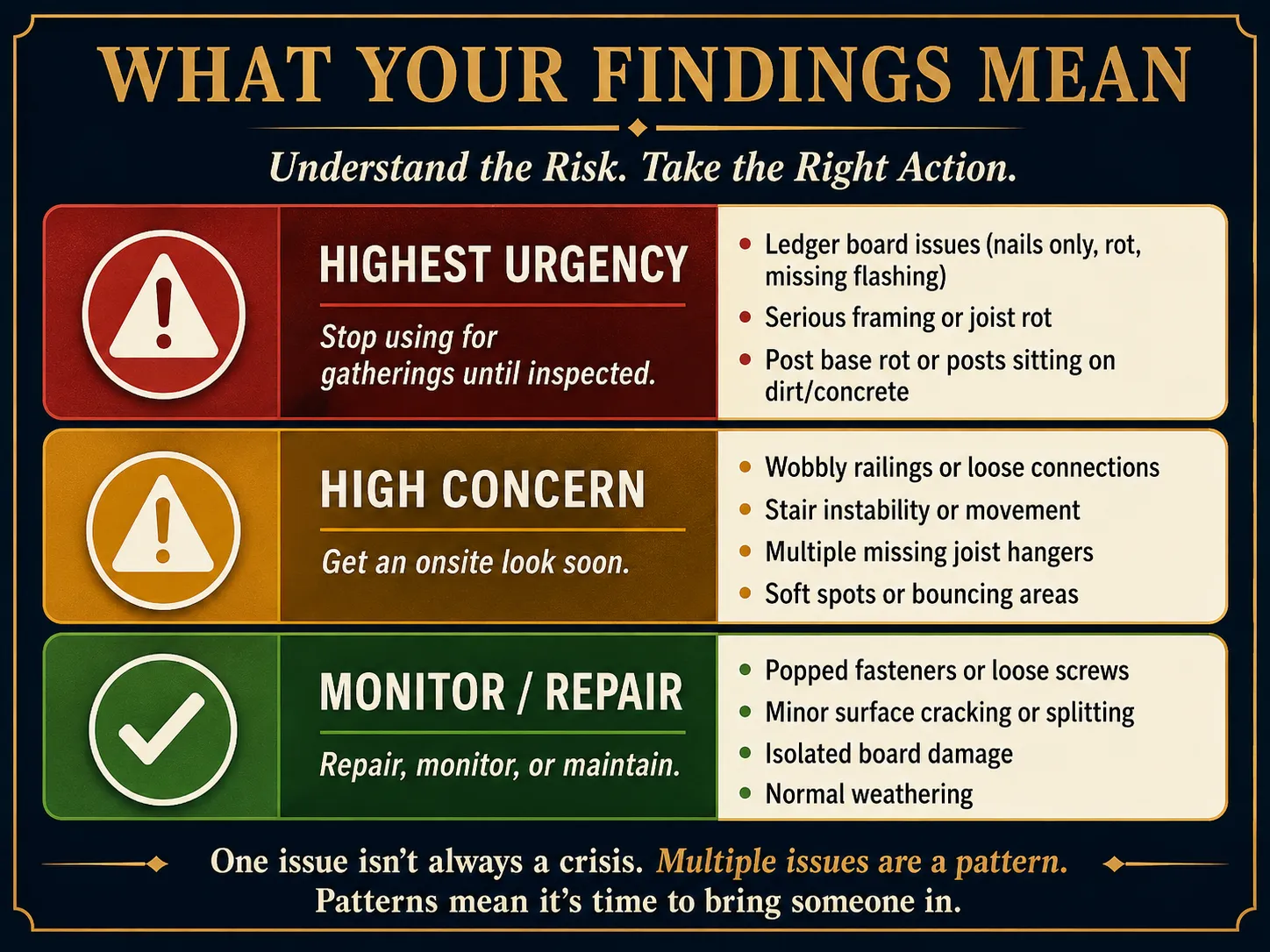
A flag on the checklist isn't an emergency. But each one of these tells a different story about what's happening to your deck — and how much time you have before it becomes one.
Ledger problems → highest urgency
If your ledger is attached with nails only, or if the flashing is gone and the wood looks dark or feels soft, this is the one that doesn't wait. Ledger failures are sudden — they don't groan, creak, or warn you. The deck is there, and then it isn't. If you flagged this one, stay off the deck until it's been looked at. That's not us being dramatic. That's the leading category of deck collapse in America, and it's not worth a holiday weekend gamble.
Post base problems → high urgency, slow timeline
A post sitting on concrete or dirt without a metal bracket has been wicking moisture for years. Most of the time, you have months before that becomes a structural problem — but if the bottom of a post sinks under a screwdriver, that timeline shrinks fast. Post replacement is one of the most common repairs we do in SW Virginia, especially on decks built in the late '90s and early 2000s.
Joist/framing problems → variable
This depends entirely on how widespread it is. One discolored joist near a downspout is a localized repair. Multiple joists with rot, missing hangers, and toenailed connections is a sign that the framing as a whole is reaching the end of its life. The honest answer is: we'd need to look. This category is the one that decides whether your deck gets a repair, a resurface (ReDeck), or a full rebuild — and you can't make that call from the surface.
Railing problems → urgent if you have kids, pets, or guests over
A wobbly railing rarely fails on a quiet Tuesday. It fails when fourteen people are on a 12x16 deck and someone leans into it the wrong way. We wrote a whole post about why railings fail and what to do about it — if your railing flagged on the check, start there.
Stair problems → don't wait
Stairs are the most common location for deck-related injuries even when nothing is collapsing. A loose stringer, a missing handrail, or a tread that's pulled away even half an inch is a fall waiting to happen. This is one of the most-fixable items on the list, and it's also one of the most-ignored.
Surface problems (fasteners, splits, soft spots) → tell you about the bones
Surface issues are almost never just surface issues. Popped nails mean the wood is moving. Soft spots mean water has gotten in. Rust streaks mean corrosion has started. Whether the fix is a few boards or a full ReDecking depends on how widespread the pattern is — and again, that's the kind of thing you can't tell from your phone, but a 30-minute walkaround tells in detail.
A Calibrated Question
If you found one issue on the check, that's a repair conversation. But if you found three or four — what does that pattern tell you?
That's not a sales line. That's the actual diagnostic question. Patterns tell a story that single issues don't.
4. What to Do With What You Find
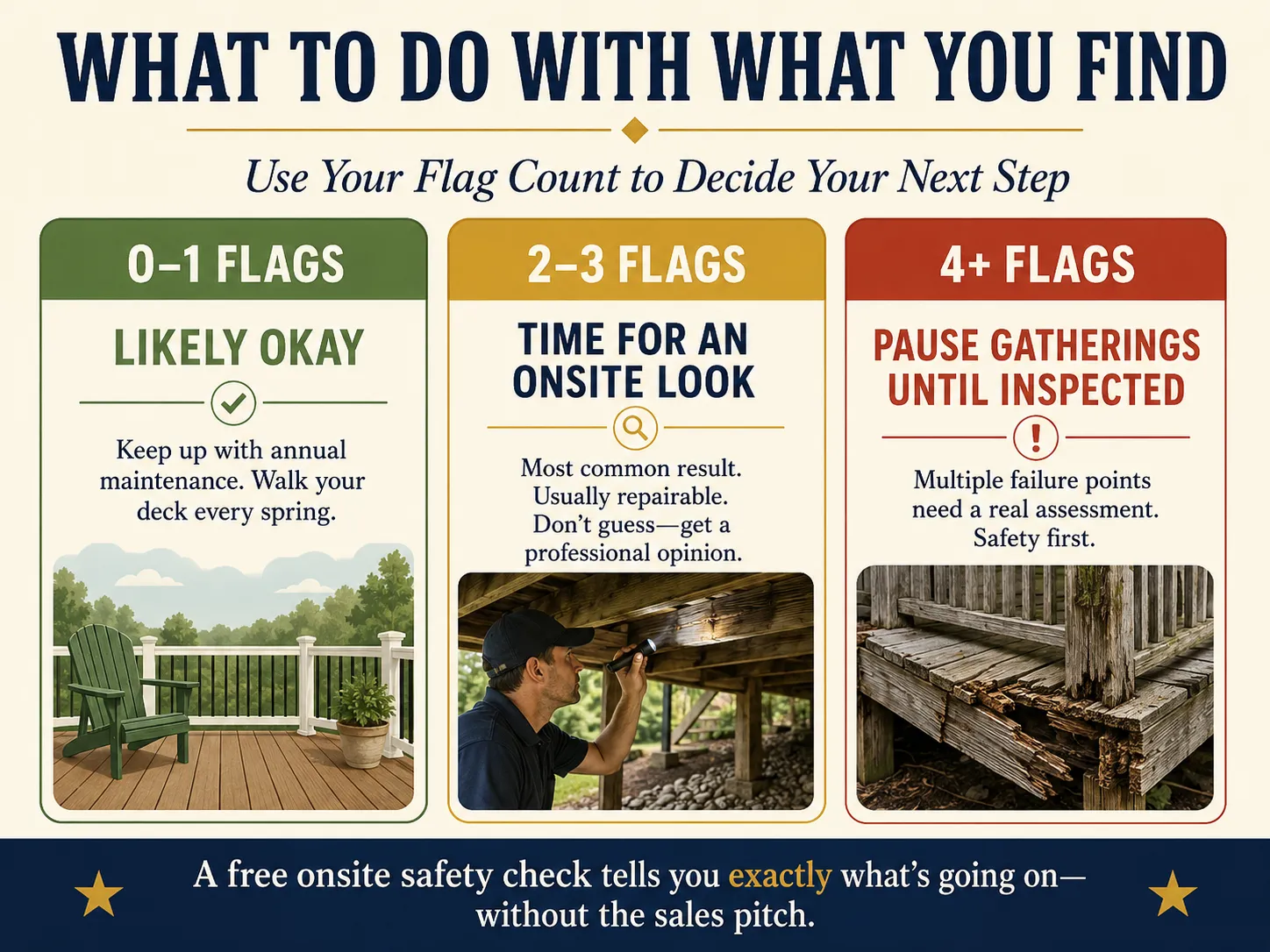
Likely Okay
You're probably in good shape. Keep an eye on whatever you flagged, do this same walkaround once a year (Deck Safety Month makes a good calendar reminder), and seal or stain wood decks every 2–3 years to keep moisture out.
Time for an Onsite Look
This is the most common result, and it's usually fixable without a full rebuild. The right next step is a real onsite look — somebody who can tell you whether what you're seeing is a localized repair or whether it's the early signal of something bigger. Don't guess. A 20-minute look from someone who does this every day is worth more than a week of internet research.
Pause Gatherings Until Inspected
Stop using the deck for gatherings until it's been inspected. We don't say that to be dramatic — we say it because that's the responsible call when a structure has multiple failure points. The good news: even decks with 4+ flags can often be saved through resurfacing (ReDecking) if the framing underneath is salvageable. The honest news: sometimes they can't, and you need to know that before someone gets hurt. Either way, the right next step is the same — a real assessment, in person, free.
5. The Truth About Deck Lifespan in SW Virginia
Here's something most homeowners don't know about decks in this part of Virginia.
Pressure-treated wood decks — the most common kind around here — are typically built with a 15-to-20-year service life expectation under ideal conditions. SW Virginia is not ideal conditions. We get summer humidity that runs through August, freeze-thaw cycles that pry connections apart every winter, heavy oak pollen that traps moisture against board surfaces in spring, and lots of decks built into shaded yards under mature hardwoods that never fully dry out.
Real-world deck life in Christiansburg, Blacksburg, Radford, Dublin, Pulaski, and Salem tends to land closer to 12–18 years for pressure-treated wood, and 20–30+ years for properly-built composite decks with good framing.
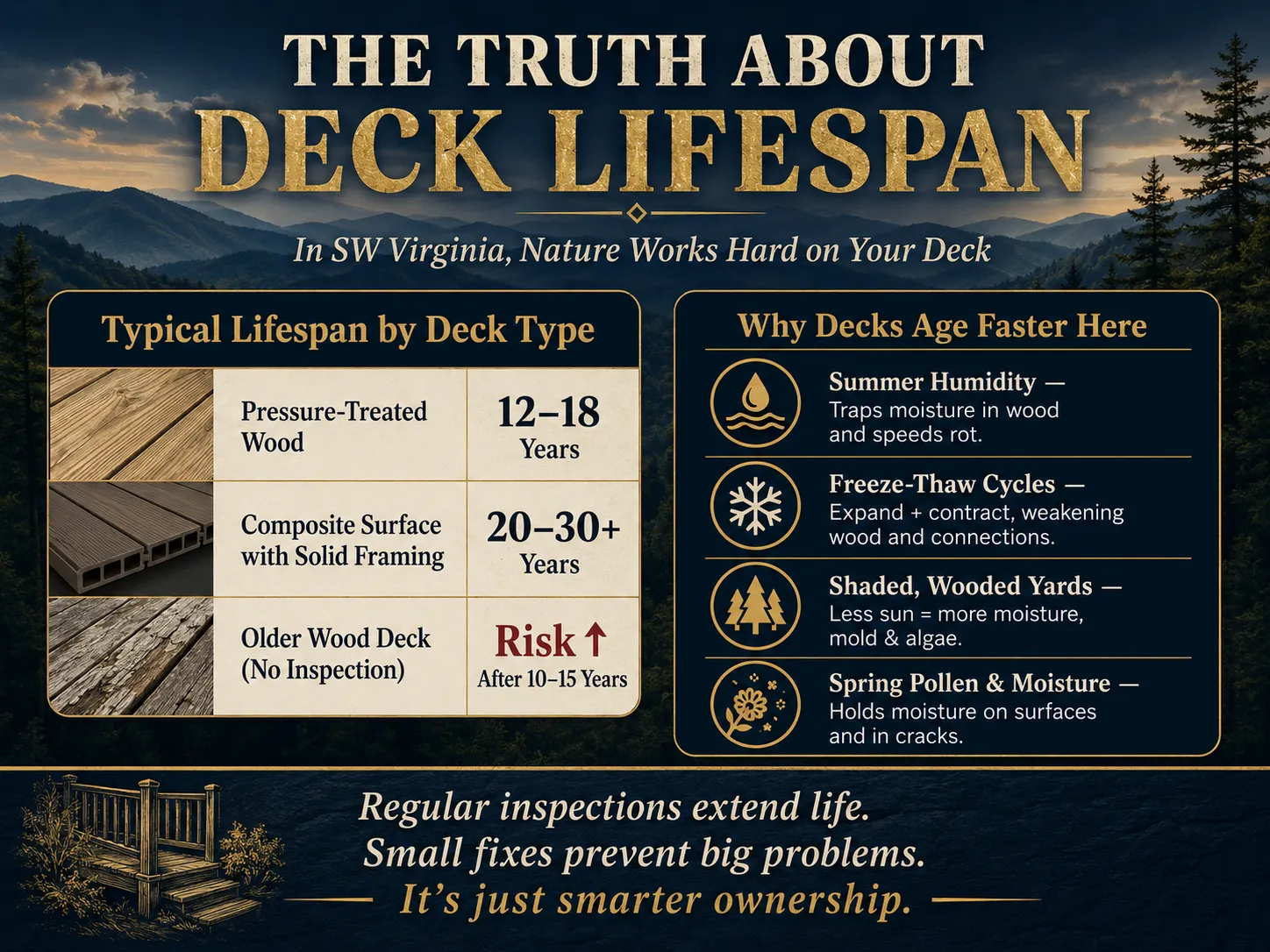
If your deck is over 15 years old and you've never had it inspected, that's not "just being cautious." That's basic upkeep — the same way you replace the brakes on your car before they fail instead of after.
The other thing worth knowing: a deck that fails an inspection isn't necessarily a deck that needs to be torn down. The framing is what matters. If the framing is still solid, ReDecking — replacing what you walk on while keeping what holds it up — saves SW Virginia homeowners thousands of dollars compared to a full rebuild. We wrote about that here: What Is Deck Resurfacing (ReDecking)? The Smart Middle Option Most Homeowners Don't Know About.
6. When to Call ReDeck Virginia
We're not the right call for every deck. If you walked through the 10-point check and everything was a clear yes — your deck looks solid, feels stable, isn't approaching the 15-year mark — you don't need us. Stain it next month and enjoy it.
You probably should call us if:
- You found multiple flags on the check and you don't know which ones are serious
- Your deck is over 12 years old and has never been professionally inspected
- You've been avoiding part of your own deck without quite admitting it
- You're hosting people this summer and you want honest answers before you do
- A different contractor has told you that you need a full rebuild, and your gut says they're upselling you
That last one happens more than people realize. We've walked onto plenty of decks where the previous quote was a $25,000 tear-down, and the actual answer was a $4,000 ReDecking with some framing reinforcement. That's not because the other contractor was lying — sometimes they genuinely thought that was the right call. But our position is that the framing tells the truth, not the surface, and we don't quote a rebuild until we've checked the bones.
What we do on a free onsite safety check:
- We look at every item on the 10-point list — and several you don't have access to
- We tell you what's safe, what isn't, and what's in between
- We give you a clear recommendation: tighten and seal, repair specific spots, ReDeck the surface, or rebuild
- We don't tell you the answer before we've checked the structure
- We don't charge you for the visit, the assessment, or the recommendation
Deck Safety Month is an annual reminder for a reason. The 20 minutes you spend on a walkaround now — and the 30 minutes we spend on a real inspection if anything turned up — is the cheapest insurance you'll ever buy on a $20,000+ outdoor structure that holds your family.
7. Frequently Asked Questions
The North American Deck and Railing Association recommends a homeowner walkaround once a year — best timed to May, which is national Deck Safety Month. A professional inspection is recommended every 3 years, or any time your deck is over 5 years old and hasn't been looked at, or any time you find multiple flags on a self-check.
It's actually free. We come to your deck, walk through the structure, give you our honest assessment, and tell you what the next step looks like. If your deck doesn't need work, we tell you that too. Our position is that an honest 'no' today builds trust for a 'yes' three years from now.
Most decks that fail looked fine until they didn't. The whole point of a structured check is that the items on the list are the ones you can't see by glancing at it. If your deck is over 10 years old and you've never checked it methodically, the 20 minutes is worth it.
If you found a ledger problem, a post that sinks under a screwdriver, or significant rot in framing: stop using the deck for gatherings until it's looked at. Call us at (540) 585-1720 and we'll get out to look. If you can't get a hold of us, call any reputable deck builder in your area — but don't wait through a holiday weekend hoping it's fine.
Yes — we handle permitting whenever it's required, including Montgomery County permits and the Town of Blacksburg, which has its own building inspections office. We've built strong working relationships with the local jurisdictions.
We serve Christiansburg, Blacksburg, Radford, Dublin, Pulaski, Salem, and surrounding SW Virginia communities. If you're not sure whether we cover your area, reach out and ask — we'll tell you quickly.
Yes — a 1-year workmanship warranty on installation, plus whatever the manufacturer warranty is on the materials we install (which on premium composite decking can run 25–50 years).
8. Get a Free Onsite Safety Check
If you've been telling yourself you'll "get to it sometime" — let's make this the year that sometime is.
We'll come to your deck. We'll check what your eyes can't see from the surface. We'll tell you the truth about what's safe, what's not, and what's in between. No high-pressure pitch, no "today only" pricing games, no charge for the visit.
You'll know exactly where your deck stands before your next family gathering — and you'll know which decision (tighten, repair, ReDeck, or rebuild) is the right one for what we actually find.
No guessing. No pressure. Just the truth about what your deck actually needs.
Before your next cookout, use the checklist — or let us walk it with you for free.
About ReDeck Virginia
ReDeck Virginia is a Class A licensed, insured deck specialist based in Christiansburg, VA, serving homeowners across the New River Valley and SW Virginia. We repair, resurface (ReDeck), and rebuild decks — and we always start by telling you the truth about what yours actually needs.